Translate

Sunday, March 10, 2013

St. John of God, Biography and History

Feastday: March 8
Patron of Booksellers
1495 - 1550


From the time he was eight to the day he died, John followed every impulse of his heart. The challenge for him was to rush to follow the promptings of the Holy Spirit gave him, not his own human temptations. But unlike many who act impulsively, when John made a decision, no matter how quickly, he stuck with it, no matter what the hardship.
At eight years old, John heard a visiting priest speak of adventures that were waiting in the age of 1503 with new worlds being opened up. That very night he ran away from home to travel with the priest and never saw his parentsagain. They begged their way from village to village untilJohn fell sick. The man who nursed him back to health, the manager of a large estate, adopted John. John worked as a shepherd in the mountains until he was 27. Feeling pressure to marry the manager's daughter, whom he loved as a sister,John took off to join the Spanish army in the war against France. As a soldier, he was hardly a model of holiness, taking part in the gambling, drinking, and pillaging that his comrades enjoyed. One day, he was thrown from a stolen horse near French lines. Frightened that he would be captured or killed, he reviewed his life and vowed impulsively to make a change.
When he returned he kept his spur of the moment vow, made a confession, and immediately changed his life. His comrades didn't mind so much that John was repenting but hated that he wanted them to give up their pleasures too. So they used his impulsive nature to trick him into leaving his post on the pretext of helping someone in need. He was rescued from hanging at the last minute and thrown out of the army after being beaten and stripped. He begged his way back to his foster-home where he worked as a shepherd until he heard of a new war with Moslems invading Europe. Off he went but after the war was over, he decided to try to find his real parents. To his grief he discovered both had died in his absence.
As a shepherd he had plenty of time to contemplate what God might want of his life. When he decided at 38 that he should go to Africa to ransom Christian captives, he quit immediately and set off for the port of Gibraltar. He was on the dock waiting for his ship when he saw a family obviously upset and grieving. When he discovered they were a noble family being exiled to Africa after political intrigues, he abandoned his original plan and volunteered to be their servant. The family fell sick when they reached their exile and John kept them alive not only by nursing them but by earning money to feed them. Hisjob building fortifications was grueling, inhuman work and the workers were beaten and mistreated by people who called themselves Catholics. Seeing Christians act this way so disturbed John that it shook his faith. A priest advised him not to blame the Church for their actions and to leave for Spain at once.John did go back home -- but only after he learned that his newly adopted family had received pardons.
In Spain he spent his days unloading ship cargoes and his nights visiting churches and reading spiritual books. Reading gave him so much pleasure that he decided that he should share this joy with others. He quit his job and became a book peddler, traveling from town to town selling religious books and holy cards. A vision at age 41 brought him to Granada where he sold books from a little shop. (For this reasonhe is patron saint of booksellers and printers.)
After hearing a sermon from the famous John of Avila on repentance, he was so overcome by the thought of his sins that the whole town thought the little bookseller had gone from simple eccentricity to madness. After the sermon John rushed back to his shop, tore up any secular books he had, gave away all his religious books and all his money. Clothes torn and weeping, he was the target of insults, jokes, and even stones and mud from the townspeople and their children.
Friends took the distraught John to the Royal Hospital where he was interned with the lunatics. Johnsuffered the standard treatment of the time -- being tied down and daily whipping. John of Avila came to visit him there and told him his penance had gone on long enough -- forty days, the same amount as the Lord's suffering the desert -- and had John moved to a better part of the hospital.
John of God could never see suffering without trying to do something about it. And now that he was free to move, although still a patient, he immediately got up and began to help the other sick people around him. The hospital was glad to have his unpaid nursing help and were not happy to release him when one day he walked in to announce he was going to start his own hospital.
John may have been positive that God wanted him to start a hospital for the poor who got bad treatment, if any, from the other hospitals, but everyone else still thought of him as a madman. It didn't help that he decided to try to finance his plan by selling wood in the square. At night he took what little money he earned and brought food and comfort to the poor living in abandoned buildings and under bridges. Thus his first hospital was the streets of Granada.
Within an hour after seeing a sign in a window saying "House to let for lodging of the poor" he had rented the house in order to move his nursing indoors. Of course he rented it without money for furnishings, medicine, or help. After he begged money for beds, he went out in the streets again and carried his ill patients back on the same shoulders that had carried stones, wood, and books. Once there he cleaned them, dressed their wounds, and mended their clothes at night while he prayed. He used his old experience as a peddler to beg alms, crying through the streets in his peddler's voice, "Do good to yourselves! For the love of God, Brothers, do good!" Instead of selling goods, he took anything given -- scraps of good, clothing, a coin here and there.
Throughout his life he was criticized by people who didn't like the fact that his impulsive love embraced anyone in need without asking for credentials or character witnesses. When he was able to move his hospital to an old Carmelite monastery, he opened a homeless shelter in the monastery hall. Immediately critics tried to close him down saying he was pampering troublemakers. His answer to this criticism always was that he knew of only one bad character in the hospital and that was himself. His urge to act immediately when he saw need got him into trouble more than a few times. Once, when he encountered a group of starving people, he rushed into a house, stole a pot of food, and gave it to them. He was almost arrested for that charity! Another time, on finding a group of children in rags, he marched them into a clothing shop and bought them all new clothes. Since he had no money, he paid for it all on credit!
Yet his impulsive wish to help saved many people in one emergency. The alarm went out that the Royal Hospital was on fire. When he dropped everything to run there, he found that the crowd was just standing around watching the hospital -- and its patients -- go up in flames. He rushed into the blazing building and carried or led the patients out. When all the patients were rescued, he started throwing blankets, sheets, and mattresses out the windows -- how well he knew from his own hard work how important these things were. At that point a cannon was brought to destroy the burning part of the building in order to save the rest. John stopped them, ran up the roof, and separated the burning portion with an axe. He succeeded but fell through the burning roof. All thought they had lost their hero until John of God appeared miraculously out of smoke. (For this reason, John of God is patron saint of firefighters.)
John was ill himself when he heard that a flood was bringing precious driftwood near the town. He jumped out of bed to gather the wood from the raging river. Then when one of his companions fell into the river, John without thought for his illness or safety jumped in after him. He failed to save the boy and caught pneumonia. He died on March 8, his fifty-fifth birthday, of the same impulsive love that had guided his whole life.
John of God is patron saint of booksellers, printers, heart patients, hospitals, nurses, the sick, and firefighters and is considered the founder of the Brothers Hospitallers.
In His Footsteps:
When you feel the urge to serve, help, or pray do you act on it or argue yourself out of it? Today if you feel an impulse to do good, do it immediately as John of God would have done without thinking of how practical or how embarrassing it might be.
Prayer:
Saint John of God, help us to act out of love as soon as we feel the promptings of the Holy Spirit. Help us learn to fight the little voices in our heads and hearts that give us all sorts of practical reasons to wait or delay in our service of God. Amen.

John of God (Spanish: Juan de Dios and Portuguese: São João de Deus) was a Portuguese-born soldier turned health-care worker in Spain, whose followers later formed the Brothers Hospitallers of St. John of God, a worldwide Catholic religious institute dedicated to the care of the poor sick and those suffering from mental disorders. He has been declared a saint by the Catholic Church, and is considered one of Spain's leading religious figures.

Biography

The first biography of John of God was written by Francisco de Castro, the chaplain at John of God’s hospital in Granada, Spain. He drew from his personal knowledge of John as a young man and also used material gathered from eyewitnesses and contemporaries of his subject. It was published at the express wish of the Archbishop of Granada, who gave financial backing to its publication. Castro began writing in 1579, twenty-nine years after John of God’s death, but he did not live to see it published, for he died soon after completing the work. His mother, Catalina de Castro, had the book published in 1585.
Shortly after the publication of Castro’s Historia, an Italian translation was published at Rome by anOratorian priest, Giovanni Bordini, in 1587. Despite a number of mistranslations and his own extraneous comments, this work became the source of most translations into other languages.

Early life


Sant Joan de Déu John of God was born João Duarte Cidad in Montemor-o-Novo, now in the District of Évora, Portugal, the son of André Cidad and Teresa Duarte, a once-prominent family that was impoverished but had great religious faith. One day, when John was eight years of age, he disappeared. Whether he had been deliberately kidnapped, or whether he had been seduced from his home by a cleric who had been given hospitality in the home, is not clear. According to his original biography, his mother died from grief soon after this and his father joined theFranciscan Order.
The young Cidad soon found himself a homeless orphan in the streets of Oropesa, near Toledo, Spain. There, in a foreign land, he had no one to care for him, nothing on which to live and he had to be content with whatever food he could find. He was eventually taken in by a man called Francisco Mayoral and the boy settled down as a shepherd caring for his sheep in the countryside.

Military life

The farmer was so pleased with Cidad's strength and diligence that he wanted him to marry his daughter and to become his heir. When he was about 22 years of age, to escape his master's well-meant, but persistent, offer of his daughter's hand in marriage, the young man joined a company of foot-soldiers, and in that company fought for the Emperor, Charles V of Spain, eventually dispatched by the Count of Oropesa, Fernando Álvarez de Toledo y Zúñiga, against French forces at Fontarabia. While serving there, he was appointed to guard an enormous heap of booty. When he was relieved it was found that much of the treasure had been rifled. Naturally suspicion fell on Cidad; even if he had not been partner in the theft, at the least he was guilty of dereliction of duty. He was condemned to be hanged, and that would have been his fate had not some more tolerant officer intervened to win his pardon.
Disillusioned by this turn of events after what he felt was faithful military service, Cidad returned to the farm in Oropesa. He then spent four years again following a pastoral life. This went on until the day that the Count and his troops marched by, on their way to fight in Hungary against the Turks. Still unmarried, he immediately decided to enlist with them, and left Oropesa for a final time. For the next 18 years he served as a trooper in various parts of Europe.
When the Count and his troops had helped in the rout of the Turks, they set sail to return to Spain, landing in A Coruna in Galicia. Since Cidad found himself so close to his homeland, he decided to return to his hometown, and to see what he could learn of the family he had lost so many years before. By that time, he had forgotten his parents' names but retained enough information from his childhood that he was able to track down an uncle he had still living in the town. He learned their fate from this uncle and, realizing that he no longer had no real ties to the region, returned to Spain.

Africa

Cidad arrived near Seville, where he soon found work herding sheep, which was familiar to him. With the time now available to him to ponder his life, he began to realize that this occupation no longer satisfied him and he felt a desire to see Africa, and possibly give his life as a martyr through working to free Christians enslaved there. He immediately set out for Ceuta (located on the western coast of Morocco), recently conquered by the Spanish. On the way, he befriended a knight also traveling there with his wife and daughters, who was being exiled to that region by the King of Portugal for some crime he had committed.
When they arrived in the colony, the knight found that the few possessions the family had been able to take with them had been stolen, leaving them penniless. Additionally the entire family had become ill. Having no other recourse, the knight appealed to Cidad for his help. He promised to care for the family, and began to nurse them and found work to provide them with food, despite the poor treatment poor Spaniards received at the hands of the colony's rulers.
The desertion of one of Cidad's coworkers to a nearby Muslim city, which meant his conversion to that faith, in order to escape this treatment led to a growing feeling of despair in him. Troubled and feeling spiritual lost from his failure to practice his faith during his years of military service, he went to the Franciscan friary in the colony. There he was advised that his desire to be in Africa was not working to his spiritual growth and that he should consider returning to Spain. He decided to do this. Landing inGibraltar, he began to wander around the region of Andalusia, trying to find what God might want from him.
It was during this period of his life that Cidad is said to have had a vision of the Infant Jesus, who bestowed on him the name by which he was later known, John of God, also directing him to go to Granada. Cidad then settled in that city, where he worked disseminating books, using the recentmoveable type printing press of Johannes Gutenberg to provide people with works of chivalry anddevotional literature.

Conversion


St. John of God saving the sick from a fire at the Royal Hospital by Manuel Gómez-Moreno González (1880)

Cidad experienced a major religious conversion on Saint Sebastian's Day (January 20) of 1537, while listening to a sermon by John of Ávila, a leading preacher of the day who was later to become his spiritual director and would encourage him in his quest to improve the life of the poor. At the age of 42 he had what was perceived at the time as an acute mental breakdown. Moved by the sermon, he soon engaged in a public beating of himself, begging mercy and wildly repenting for his past life. He was incarcerated in the area of the Royal Hospital reserved for the mentally ill and received the treatment of the day, which was to be segregated, chained, flogged, and starved. Cidad was visited by John of Avila, who advised him to be more actively involved in tending to the needs of others rather than in enduring personal hardships. John gained peace of heart, and shortly after left the hospital to begin work among the poor.
Cidad expended all his energy in caring for the neediest people of the city. He established a house where he wisely tended to the needs of the sick poor, at first doing his own begging. When John began to put into effect his dream because of the stigma attached to mental illness he found himself misunderstood and rejected.  For some time he was alone in his charitable work, soliciting by night the needed medical supplies, and by day attending to the needs of his patients and the hospital; but he soon received the cooperation of charitable priests and physicians. Many stories are related of the heavenly guests who visited him during the early days of his immense tasks, which were lightened at times by the archangel St. Raphael in person. To put a stop to his custom of exchanging his cloak with any beggar he chanced to meet, Sebastian Ramirez, Bishop of Tuy, had a religious habit made for him, which was later adopted in all its essentials as the religious garb of his followers, and the bishop imposed on him for all time the name given him by the Infant Jesus, John of God.

Brothers Hospitallers


Statue of St. John of God at the Church of Vilar de Frades, Barcelos, Portugal.
The inscription reads: 
All things pass, only good works last.

Slowly John drew to himself a dedicated circle of disciples who felt called to join him in this service. He organized his followers into the Order of Hospitallers, who were approved by the Holy See in 1572 as the Brothers Hospitallers of St. John of God, who care for the sick in countries around the world. One mark of honour to his labours is that this Order has been officially entrusted with the medical care of the pope.

Veneration

John of God died on March 8, 1550, his 55th birthday, in Granada. His body was initially buried in the Church of Our Lady of the Victories, belonging to the Minim friars, and remained there until November 28, 1664, when the Hospitaller Brothers had his relics moved to the church of their hospital in the city,
John was canonized by Pope Alexander VIII on October 16, 1690, and later named the patron saint of hospitals, the sick, nurses, firefighters, alcoholics, and booksellers. Hisfeast day is celebrated on March 8. A church was erected in 1757 to house his remains. On October 26, 1757, they were transferred to that church, now protected by theKnights of Saint John of God. The church has been raised to the rank of a basilica

Legacy

Down the centuries and across the world, today the Order has a presence in 53 countries and more than 300 hospitals, services and centers that respond to a whole variety of needs, not just in the area of mental health and psychiatry but other areas of needs as well. The Family of Saint John of God, as the Order is referred to today, is made up of more than 45,000 members, Brothers and Co-workers, and supported by tens of thousands of benefactors and friends who identify with and support the work of the Order for sick and needy people across the world.

Sts. Perpetua and Felicity, Bio & Prayers

Feastday: March 7

With the lives of so many early martyrs shrouded in legend, we are fortunate to have the record of the courage of Perpetua and Felicity from the hand of Perpetua herself, her teacher Saturus, and others who knew them. This account, known as "The Martyrdom of Perpetua and Felicity," was so popular in the early centuries that it was read during liturgies.
In the year 203, Vibia Perpetua made the decision to become a Christian, although she knew it could mean her death during Septimus' persecution. Her surviving brother (another brother had died when he was seven) followed her leadership and became a catechumen as well.
Her father was frantic with worry and tried to talk her out of her decision. We can easily understand his concern. At 22 years old, this well-educated, high-spirited woman had everyreason to want to live -- including a baby son who was still nursing. We know she was married, but since her husband is never mentioned, many historians assume she was a widow.
Perpetua's answer was simple and clear. Pointing to a water jug, she asked her father, "See that pot lying there? Can you call it by any other name than what it is?"
Her father answered, "Of course not." Perpetua responded, "Neither can I call myself by any other name than what I am -- a Christian."
This answer so upset her father that he attacked her. Perpetua reports that after that incident she was glad to be separated from him for a few days -- even though that separation was the result of her arrest and imprisonment.
Perpetua was arrested with four other catechumens including two slaves Felicity and Revocatus, and Saturninus and Secundulus. Their catechist, Saturus, had already been imprisoned before them.
She was baptized before taken to prison. Perpetua was known for her gift of "the Lord's speech" and receiving messages from God. She tells us that at the time of her baptism she was told to pray for nothing but endurance in the face of her trials.
The prison was so crowded with people that the heat was suffocating. There was no light anywhere and Perpetua "had never known such darkness." The soldiers who arrested and guarded them pushed and shoved them without any concern. Perpetua had no trouble admitting she was very afraid, but in the midst of all this horror her most excruciating pain came from being separated from her baby.
The young slave, Felicity was even worse off for Felicity suffered the stifling heat, overcrowding, and rough handling while being eight months pregnant.
Two deacons who ministered to the prisoners paid the guards so that the martyrs would be put in a better part of the prison. There her mother and brother were able to visit Perpetua and bring her baby to her. When she received permission for her baby to stay with her "my prison suddenly became a palace for me." Once more her father came to her, begging her to give in, kissing her hands, and throwing himself at her feet. She told him, "We lie not in our own power but in the power of God."
When she and the others were taken to be examined and sentenced, her father followed, pleading with her and the judge. The judge, out of pity, also tried to get Perpetua to change her mind, but when she stood fast, she was sentenced with the others to be thrown to the wild beasts in the arena. Her father was so furious that he refused to send her baby back to Perpetua. Perpetua considered it a miracle that her breasts did not become inflamed from lack of nursing.
While praying in prison, she suddenly felt "gifted with the Lord's speech" and called out the name of her brother Dinocrates who had died at seven of gangrene of the face, a disease so disfiguring that those who should have comforted him left him alone. Now she saw a vision that he was even more alone, in a dark place, hot and thirsty -- not in the eternal joy she hoped for him. She began to pray for Dinocrates and though she was put in stocks every day, her thoughts were not on her own suffering but on her prayersto help her brother. Finally she had another vision in which she saw Dinocrates healed and clean, drinking from a golden bowl that never emptied.
Meanwhile Felicity was also in torment. It was against the law for pregnant women to be executed. To kill a child in the womb was shedding innocent and sacred blood. Felicity was afraid that she would not give birth before the day set for their martyrdom and her companions would go on their journey without her. Her friends also didn't want to leave so "good a comrade" behind.
Two days before the execution, Felicity went into a painful labor. The guards made fun of her, insulting her by saying, "If you think you suffer now, how will stand it when you face the wild beasts?" Felicity answered them calmly, "Now I'm the one who is suffering, but in the arena Another will be in me suffering for me because I will be suffering for him." She gave birth to a healthy girl who was adopted and raised by one of the Christian women of Carthage.
The officers of the prison began to recognize the power of the Christians and the strength and leadership of Perpetua. In some cases this helped the Christians: the warden let them have visitors -- and later became a believer. But in other cases it caused superstitious terror, as when one officer refused to let them get cleaned up on the day they were going to die for fear they'd try some sort of spell. Perpetua immediately spoke up, "We're supposed to die in honor of Ceasar's birthday. Wouldn't it look better for you if we looked better?" The officer blushed with shame at her reproach and started to treat them better.
There was a feast the day before the games so that the crowd could see the martyrs and make fun of them. But the martyrs turned this all around by laughing at the crowd for not being Christians and exhorting them to follow their example.
The four new Christians and their teacher went to the arena (the fifth, Secundulus, had died in prison) with joy and calm. Perpetua in usual high spirits met the eyes of everyone along the way. We are told she walked with "shining steps as the true wife of Christ, the darling of God."
When those at the arena tried to force Perpetua and the rest to dress in robes dedicated to their gods, Perpetua challenged her executioners. "We came to die out of our own free will so we wouldn't lose our freedom to worship our God. We gave you our lives so that we wouldn't have to worship your gods." She and the others were allowed to keep their clothes.
The men were attacked by bears, leopards, and wild boars. The women were stripped to face a rabid heifer. When the crowd, however, saw the two young women, one of whom had obviously just given birth, they were horrified and the women were removed and clothed again. Perpetua and Felicity were thrown back into the arena so roughly that they were bruised and hurt. Perpetua, though confused and distracted, still was thinking of others and went to help Felicity up. The two of them stood side by side as all five martyrs had their throats cut.
Perpetua's last words were to her brother: "Stand fast in the faith and love one another."
In Their Footsteps:
Perpetua said that she couldn't call herself any other name but Christian. Write down a list of names and designations that people could call you. Is Christian high on that list? How can you help make your name as Christian be more important? Live today as if that was the only name you could be called by.
Prayer:
Saints Perpetua and Felicity, watch over all mothers and children who are separated from each other because of war or persecution. Show a special care to mothers who are imprisoned and guide them to follow your example of faith and courage. Amen

PRAYER TO ST CASIMIR


SAINT CASIMIR; MEMORIAL: MARCH 4

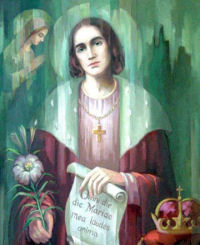
St Casimir was born in Poland in 1458, son of the King Casimir IV of Poland. He died in 1484. He was intelligent and generous, involved in public affairs, but first and foremost a man of prayer. His devotion to the Blessed Sacrament and to Our Lady were most marked; he served the poor, and endeavoured to live a holy and pure life.
PRAYER:
All-powerful God,
to serve you is to reign:
by the prayers of Saint Casimir,
help us to serve you in holiness and justice.
Through our Lord Jesus Christ, your Son,
who lives and reigns with you
in the unity of the Holy Spirit,
one God, for ever and ever.
Amen.

The Liturgical Year, St. Casimir

by Fr. Prosper Gueranger

It is from a Court that we are to be taught today the most heroic virtues. Casimir is a Prince; he is surrounded by all the allurements of youth and luxury; and yet be passes through the snares of the world with as much safety and prudence, as though he were an Angel in human form. His example shows us what we may do. The world has not smiled on us as it did on Casimir; but, how much we have loved it! If we have gone so far as to make it our idol, we must now break what we have adored, and give our service to the Sovereign Lord, who alone has a right to it. When we read the Lives of the Saints, and find that persons, who were in the ordinary walk of life, practised extraordinary virtues, we are inclined to think that they were not exposed to great temptations, or that the misfortunes they met in the world, made them give themselves up unreservedly to God's service. Such interpretations of the actions of the Saints are shallow and false, for they ignore this great fact, that there is no condition or state, however humble, in which man has not to combat against the evil inclinations of his heart, and that corrupt nature alone is strong enough to lead him to sin.

But in such a Saint as Casimir, we have no difficulty in recognising that all his Christian energy was from God, and not from any natural source; and we rightly conclude, that we, who have the same good God, may well hope that this Season of spiritual regeneration will change and better us. Casimir preferred death to sin. But is not every Christian bound to be thus minded every' hour of the day? And yet, such is the infatuation produced by the pleasures or advantages of this present life, that we, every day, see men plunging themselves into sin, which is the death of the soul; and this, not for the sake of saving the life of the body, but for a vile and transient gratification, which is oftentimes contrary to their temporal interests. What stronger proof could there be than this, of the sad effects produced in us by Original Sin. The examples of the Saints are given us as a light to lead us in the right path : let us follow it, and we shall be saved. Besides, we have a powerful aid in their merits and intercession: let us take courage at the thought, that these Friends of God have a most affectionate compassion for us their Brethren, who are surrounded by so many and great dangers.

The Church, in her Liturgy, thus describes to us the virtues of our young Prince. Casimir was the son of Casimir, king of Poland, and of Elizabeth of Austria. He was put, when quite a boy, under the care of the best masters, who trained him to piety and learning. He brought his body into subjection by wearing a hairshirt, and by frequent fasting. He could not endure the soft bed which is given to kings, but lay on the hard floor, and during the night, he used privately to steal from his room, and go to the Church, where, prostrate before the door, lie besought God to have mercy on him. The Passion of Christ was his favourite subject of meditation; and when he assisted at Mass, his mind was so fixed on God, that he seemed to be in one long ecstacy.

Great was his zeal for the propagation of the Catholic faith, and the suppression of the Russian schism. He persuaded the king, his father, to pass a law, forbidding the schismatics to build new churches, or to repair those which had fallen to ruin. Such was his charity for the poor and all sufferers, that he went under the name of the Father and Defender of the Poor. During his last illness, he nobly evinced his love or purity, which virtue he had maintained unsullied during his whole life. He was suffering a cruel malady; but he courageously preferred to die, rather than suffer the loss, whereby his physicians advised him to purchase his cure, the loss of his priceless treasure.

Being made perfect in a short space of time, and rich in virtue and merit, after having foretold the day of his death, he breathed forth his soul into the hands of his God, in the twenty-fifth year of his age, surrounded by priests and religious. His body was taken to Vilna, and was honoured by many miracles. A young girl was raised to life at his shrine; the blind recovered their sight, the lame the use of their limbs, and the sick their health.

He appeared to a small army of Lithuanians, who were unexpectedly attacked by a large force, and gave them the victory over the enemy. Leo the Tent was induced by all these miracles to insert his name among the Saints.
The Roman Breviary
Great was his zeal for the propagation of the Catholic faith, and the suppression of the Ruthenian schism; wherefore he persuaded his father to pass a law forbidding the schismatics to build new churches, or to repair dilapidated ones. Such was his charity to the poor and all sufferers, that he won the name of father and defender of the needy. At the end of his life when critically ill, he bravely affirmed his regard for his virginity, which he had kept unimpaired from the cradle. Physicians advised him to seek relief from his sufferings by sacrificing his chastity, but he firmly determined rather to die.

Made perfect in a short time, and rich in virtue and merit, he foretold the day of his death and gave back his soul to God, in his twenty-fifth year, surrounded by priests and religious. His body was taken to Vilna, and is famous for many miracles. For not only was a dead girl raised to life, but the blind recovered their sight, the lame the use of their limbs, and persons with various ailments regained their health at his tomb; and he appeared in the sky to a small party of Lithuanians, who were afraid of a sudden attack by a large force, and gave them a remarkable victory. Leo X was induced by these miracles to add his name to the list of the Saints.

The Hymn of St. CasimirThe Hymn of St. Casimir


A Devout Hymn in honour of the Mother of God (ascribed to St. Anselm), which St. Casimir of Poland was accustomed daily to recite, and which, in the year 1604, at the renewal of his shrine, was found lying under his head.

DECADE I.
OMNI DIE DIC MARIAE

From day to day sing loud thy lay
To Mary's name, O soul of mine;
And freely praise her festal days
And actions of her life divine.

And let thine eyes, in glad surprise,
Gaze on her wondrous dignity;
Sing through the earth the Mother's worth,
And sing the Maiden's purity.

Oh, bend thee low, and pray that thou
Be lightened of thy weight of sin;
Call her to thee, lest the dark sea
Of sin divide and whelm thee in.

Her hand hath given the gifts of Heaven
To us who own her matchless worth;
A Queen Divine, her graces shine
Bright over all in Heaven and earth.

Come then, my tongue, raise high the song,
To her, the Maid and Mother too;
Who, by her Son, hath now undone
The early curse that wrought our woe.

This Queen of power (the world her dower)
Be the sweet subject of thy song;
Her graces fair, her glories rare,
Resound from thy exulting tongue.

Her peerless worth, from this time forth,
Let my conspiring senses sing;
By day and night my sweet delight
Shall be her blest remembering.

Thou wilt not find, 'midst all mankind,
A tongue of such rare eloquence,
Fit to repeat the praises sweet
Of Mary's sovereign excellence.

Yet all are free, in their degree,
God's Virgin-Mother to confess;
A joy to each, though none may reach
The height of her great worthiness.

Whoso are fain her love to gain,
With earnest mind her praise must sing;
For ever thus flow down to us
Rich streams from this thrice-hallowed spring.

Hail Mary.

DECADE II.
QUAMVIS SCIAM, QUOD MARIAM.


What though I know no tongue below
May rightly speak of Mary's grace;
Unwise the man, most vain, who can
Hear her sweet name and hold his peace.

Error and guile, each snare, each wile,
Her power doth ever bring to nought;
She shineth forth o'er all the earth
With Heaven's eternal wisdom fraught.

Her virtues rare, like flowerets fair,
Adorn the Church's garden-bed;
Her actions each, her every speech,
So many wondrous graces shed.

In early time, Eve's fatal crime
Did shut the gates of Paradise;
But our new Eve doth straight believe,
Obedient, and re-opes the skies.

Through sinful Eve mankind receive
The doom severe of banished men;
But Mary sweet our joyful feet
Leads to our happy home again.

Her then we love, and praise above
All creatures else in Heaven and earth;
To her we pray, and ceaseless pay
Our highest homage to her worth.

To her I sue, with reverence due,
Whose sovereign power I own with joy;
And meekly pray she chase away
Whate'er may work the soul's annoy.

Oh, may she give that I may live
Obedient to her Son's command;
And when my doom of death shall come,
Full in His blissful presence stand.

O fairest, best, O Queen confest,
O honour bright of woman's race,
Chosen of Heaven, to thee is given
To rise and take the chiefest place.

Mother most dear, incline thine ear
To us who sing these songs to thee;
Cleansed of our sin, help us to win
The life that lasts eternally.

O stately shoot of Jesse's root,
That bears the flower of hope Divine;
The world's clear light, its glory bright,
God's temple, yea, his inner shrine.

Hail Mary.

DECADE III.
VITAE FORMA, MORUM NORMA.


Virtue's best school, our truest rule,
Fulness of grace and blessedness,
The temple bright of living light,
Pattern of perfect righteousness.

Hail, Virgin blest, the gate of rest
Thou unto sinners openest wide;
Nor serpent's guile, nor crafty wile,
Could ever bend thy steps aside.

O wondrous fair, thy beauty rare
Hath smitten e'en the King Divine;
His chosen bride o'er all beside,
Fair daughter of King David's line.

O jewel bright, O lily white
Of purity, O fresh-blown rose,
Thou dost command the Virgin-band
That aye through Heaven rejoicing goes.

Oh, give me power, each changing hour,
By act and word to tell thy praise;
With willing tongue and boldest song
To sing of all thy perfect ways.

With earnest vow, I pray that thou
Be ever present to my mind;
That I may sing unwearying
Thy praises free and unconfined.

What though I know my lips are slow
And stained with much iniquity?
I'll boldly dare my part to bear
In the sweet songs that rise to thee.

Rejoice, rejoice, for every voice
Brings tribute due unto thy name;
Thou art confest the occasion blest
Through which our great Redemption came.

Pure as the dew, as fertile too,
Thou, a chaste Maid, dost bear a Child;
O stately palm, a healing balm
Breathes from thy flowers and fruitage mild.

Oh, still may we delighted be
With thy rich bloom and odorous breath,
Whose Fruit adored (our gracious Lord),
Hath freed us from the woes of death.

Hail Mary.

DECADE IV.
PULCHRA TOTA SINE NOTA.


Thou art all fair, thy beauty rare
Was ever spotless; grant that we
At every hour may sing thy power
With earthly hearts made chaste through thee.

O blest of Heaven, through thee are given
New joys this weeping world to cheer;
Through thee once more the heavenly choir
Stands wide to contrite sinners here.

Through thee the earth comes glorious forth
Exulting in the new-born light;
For now at last for aye are past
The shadows of the ancient light.

Well didst thou say one happy day:
"The lowly are exalted high,
The needy poor have food in store;"
So didst thou meekly prophesy.

Sin's devious ways, whose endless maze
Erewhile thy children's footsteps traced,
They tread no more; and thy sweet power
False doctrine far away hath chased.

Well hast thou taught to set at naught
The world and all its fleeting show;
Deny the flesh its wanton wish;
Seek God; and passion's pride subdue.

The mind lift high beyond the sky
In humble following of our Lord;
The body wear by fast and prayer
For Heaven's ineffable reward.

O Maiden chaste, thy womb embraced
The Lord, Redeemer of mankind;
And thus do we regain through thee
Our life, and our lost honours find.

A Mother true, a Maiden too,
Thou dost bring forth the King of kings
Who dwelleth high above the sky,
Lord over all created things.

Thrice blest, through whom to us doth come
The victory o'er our crafty foe;
And peace is given by pitying Heaven
To sinners sunk in hopeless woe.

Hail Mary.

DECADE V.
BENEDICTUS REX INVICTUS.


Blest is the King all-conquering
Whose Mother thou art owned to be;
Who brings our race its Saving Grace,
The Uncreated, born of thee.

Come thou, who best with comfort blest
Canst heal the sick and drooping mind,
Free us from all the woes that fall
On Satan's children, proud and blind.

Pray that my soul may reach the goal
Where saints their happy rest do take;
O Mother see, I never be
Plunged in the dark and fiery lake.

All that I seek, O Mother meek,
Is that thou heal each wound of mine;
And that my mind may ever find
In thee these gifts of grace Divine.

To be all chaste and sweetly graced
With modesty of sober life,
Of mind correct and circumspect,
Meek-hearted, gentle, hating strife;

A plenteous store of needful lore,
Drawn from the oracles of Heaven;
A filial awe to search God's law;
A life to contemplation given.

A purpose fixed, a sweetness mixed
With gravity; kind and benign,
Simple and pure, of thought mature,
A lowly patience like to thine;

That heavenly truth be in my mouth
And in my understanding heart,
All sin to hate, and venerate
My God with every pious act.

Oh, come, be thou our teacher now,
The helper of Christ's people here;
Grant us thy peace, a blest release
From strife with this world's godless will.

Star of the Sea, all hail to thee,
Safe guide through ocean's perilous ways,
The stars that rise to light the skies,
They pale before thy sovereign rays.

Hail Mary.

Decade VI.
TUA DULCI PRECE FULCI.


Support and cheer thy suppliants here,
And help us with thy pleading love;
Whatever weight doth aggravate,
Or warp our minds, do thou remove.

Be joyful now, blest Maid, for thou
Hast freed our souls from Satan's fraud;
Since from thy womb to us hath come,
In very flesh, our very God.

O Virgin pure, how rich a dower,
In thy dear Son, doth come to thee;
To nurse thy Child, yet undefiled
To keep the flower of purity.

Thou'rt still the same for Maiden fame;
And still thou art a Mother blest;
And He from whom thy life doth come
Is the Sweet Babe that seeks thy breast.

In grief I pine; but, Mother mine,
Come thou and give me of thy joy;
Come and impart to my sick heart
The remedy for which I sigh.

Deign to commend, O Mother-friend,
My anxious heart to Christ Thy Child;
So, though the world a wreck be hurled,
I may escape the waters wild.

Grant that my life be free from strife,
Meek and of perfect modesty:
Through all my days tread guileless ways,
In firm unwavering constancy.

Let not the chain of wishes vain
E'er twine around my captive heart;
Strive but to blind the hardened mind
Of those who choose the evil part.

Nor rage, nor hate, nor pride elate,
E'er hold my soul their captive slave;
Whence frequent flows a tide of woes,
That threatens all with whelming wave.

Oh, pray thy Child, that reconciled
This heart henceforth His law embrace;
And that the foe ne'er oversow
His tares, to choke the seeds of grace.

And give thine aid, O Mother-Maid,
Thy comfort sweet to all who join
Their songs to praise thy festal days
And actions of thy life divine.

Hail Mary.


Prayer to St. Casimir

Enjoy thy well-earned rest in heaven, O Casimir ! Neither the world with all its riches, nor the court with all its pleasures, could distract thy heart from the eternal joys it alone coveted and loved. Thy life was short, but full of merit. The remembrance of heaven made thee forget the earth. God yielded to the impatience of thy desire to be with him, and took thee speedily from among men. Thy life, though most innocent, was one of penance, for knowing the evil tendencies of corrupt nature, thou hadst. a dread of a life of comfort. When shall we be made to understand that penance is a debt we owe to God, a debt of expiation for the sins we have committed against him? Thou didst prefer death to sin; get us a fear of sin, that greatest of all the evils that can befal us, because it is an evil which strikes at God himself. Pray for us during this holy Season, which is granted us that we may do penance. The Christian world is honouring thee today; repay its homage by thy blessing. Poland, thy fatherland, is in mourning; comfort her. She was once the bulwark of the Church, and kept back the invasion of schism, heresy, and infidelity; and now she is crushed by tyrants, who seek to rob her of her faith; pray for her that she may be freed from her oppressors, and, by regaining her ancient zeal for the faith, be preserved from the apostacy into which her enemies are seeking to drive her.


St. Casimir Biography and History

Saint Casimir Jagiellon (PolishKazimierzLithuanianKazimieras; October 3, 1458 – March 4, 1484) was a crown prince of theKingdom of Poland and of the Grand Duchy of Lithuania who became a patron saint of LithuaniaPoland, and the young. His feast day, the Saint Casimir's Day, is marked annually with Kaziuko mugė (a trade fair) held on the Sunday nearest to March 4, the anniversary of his death, in Vilnius.

Early life and education

A member of the Jagiellon dynasty, Casimir was born at Wawel, the royal palace in Kraków (in present-day Poland). Casimir was the third child and the second son of the King of Poland and Grand Duke of Lithuania Casimir IV and Queen Elisabeth Habsburg of Hungary. Elisabeth was a loving mother and took active interest in her children's upbringing. The Queen and the children often accompanied the King in his annual trips to the Grand Duchy of Lithuania.
From the age of nine, Casimir and his brother Vladislaus II were educated by the Polish priest Jan Długosz. The boys were taught Latin and German, law, history, rhetoric, and classical literature. Długosz was a strict and conservative teacher who emphasized ethics, morality, and religious devotion. According to Stanisław Orzechowski (1513–1566), the princes were subject to corporal punishment which was approved by their father. Długosz noted Casimir's skills in oratory when he delivered speeches to greet his father returning to Poland in 1469 and Jakub Sienienski, the Bishop of Kujawy, in 1470.

Hungarian campaign

Main articles: Bohemian War (1468–1478) and Black Army of Hungary

Poland amassed an army of 12,000 men, commanded by Piotr Dunin and Dziersław of Rytwiany. Both King Casimir and Prince Casimir participated in the campaign. In October 1471, the Polish army crossed the Hungarian border and slowly marched towards Buda. Matthias Corvinus managed to win over the majority of the Hungarian nobles, including the main conspirator Archbishop János Vitéz, and the Polish army did not receive the expected reinforcement. Only Deák, Perény and Rozgonyi families sent troops. Upon hearing that Corvinus' army of 16,000 men camped outside of Pest, the Polish army decided to retreat from Hatvan to Nitra. There the soldiers battled food shortages, spreading infectious diseases, and the upcoming winter. The Polish King also lacked funds to pay the mercenaries. As a result, the Polish army decreased by about a third. In December 1471, Prince Casimir, fearing for his safety, was sent to Jihlava closer to the Polish border and further eroded their soldier's morale. Corvinus took Nitra and a one-year truce was completed in March 1472 in Buda. Prince Casimir returned to Kraków to resume his studies with Długosz.St. Casimir's uncle Ladislaus the PosthumousKing of Hungary and Bohemia, died in 1457 at the age of 17, without leaving an heir. St. Casimir's father, King Casimir IV, subsequently advanced his claims to Hungary and Bohemia, but could not enforce them due to theThirteen Years' War (1454–66). Instead, Hungarian nobles elected Matthias Corvinus and Bohemian nobles selected George of Poděbrady as their kings. George of Poděbrady died in March 1471. In May 1471, Vladislaus II, eldest son of Casimir IV, was elected to the throne of Bohemia. However, a group of Catholic Bohemian nobles supported Matthias Corvinus instead of Vladislaus II. In turn, a group of Hungarian nobles conspired against Matthias Corvinus and invited the Polish king to overthrow him. King Casimir IV decided to install his son, future Saint Casimir, in Hungary.
Długosz remarked that Prince Casimir felt "great sorrow and shame" regarding the failure in Hungary. Polish propaganda, however, portrayed him as a savior, sent by divine providence, to protect the people from a godless tyrant (i.e. Matthias Corvinus) and marauding pagans (i.e. Muslim Ottoman Turks). Prince Casimir was also exposed to the cult of his uncle King Władysław III of Poland who died in the 1444 Battle of Varna against the Ottomans. This led some researchers, including Jacob Caro, to conclude that the Hungarian campaign pushed Prince Casimir into religious life.

Heir apparent

As his elder brother, Vladislaus II, ruled Bohemia, Prince Casimir became crown prince and heir apparent to the throne of Poland and Lithuania. Italian humanist writer Filippo Buonaccorsi (also known as Filip Callimachus) was hired to become Casimir's tutor in political matters, but his Renaissance views had less influence on Casimir than Długosz. In 1474, the Italian merchant and traveler Ambrogio Contarini met with Prince Casimir and was impressed by his wisdom. Prince Casimir completed his formal education at age 16 and spent most of his time with his father. In 1476, Prince Casimir accompanied his father to Royal Prussia where he tried to resolve the conflict with the Prince-Bishopric of Warmia (see War of the Priests). In 1478 Seimas of the Grand Duchy of Lithuania demanded that King Casimir IV leave either Prince Casimir or Prince John I Albert in Lithuania as a regent. King Casimir IV feared separatist moods and refused, but after settling the conflict in Prussia, moved to Vilnius.
Between 1479 and 1484 his father spent most of his time in Vilnius attending to the affairs of Lithuania. In 1481, Mikhailo Olelkovich and his relatives planned to murder King Casimir and Prince Casimir during a hunt at a wedding of Feodor Ivanovich Belsky. The plan was discovered and Prince Casimir, perhaps fearing for his safety, was sent to Poland to act as vice-regent. Around the same time his father tried to arrange a marriage with Kunigunde of Austria, daughter of Emperor Frederick III. It is often claimed that Prince Casimir refused the match, preferring to remain celibate and sensing his approaching death. According to Maciej Miechowita, Prince Casimir developed tuberculosis. In May 1483, Prince Casimir joined his father in Vilnius. There, after the death of Andrzej Oporowski, Bishop and Vice-Chancellor of the Crown, Prince Casimir took over some of his duties in the chancellery. However, his health deteriorated while rumors about his piousness and good deeds spread further. He was known for his charitable work and help to the needy. In February 1484, the Polish ''general sejm'' (parliament) in Lublin was aborted as King Casimir IV rushed back to Lithuania to be with his ill son. Prince Casimir died on March 4, 1484, in Hrodna. His remains were interred in Vilnius Cathedral, where a dedicated Saint Casimir's Chapel was built in 1636.