Translate

Showing posts with label Bio's. Show all posts

Sunday, March 17, 2013

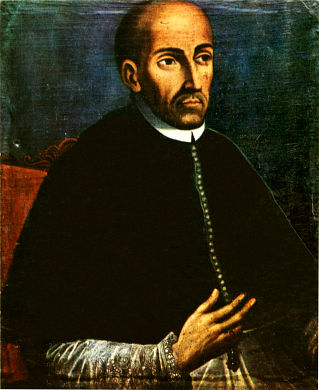
St. Turibius of Mogrovejo


Feast Day: March 23
1538-1606

St Toribio, or Turibius Alphonsus Mogrobejo, was second son to the lord of Mogrobejo, and born in the kingdom of Leon, on the 16th of November, in 1538. From his infancy he discovered a strong inclination to piety; and in his childhood it was his delight, at times of recreation, to erect and adorn altars, and to serve the poor. He trembled at the very shadow of sin. One day, seeing a poor peddler woman angry because she had lost something out of her pack, he most movingly entreated and exhorted her that she would not offend God by passion; and, in order to appease her, gave her the value of her loss, which he had begged of his mother for that purpose. He was very devout to the Blessed Virgin, said every day her office and rosary, and fasted every Saturday in her honour. Whilst at school, he usually gave part of his slender dinner to the poor, and was so much addicted to fasting that his superiors were obliged, by strict commands, to compel him to moderate his austerities. He began his higher studies at Valladolid, but completed them at Salamanca. He was introduced early to the notice of King Philip II, honoured by him with several dignities, and made president or chief judge at Granada. This office he discharged during five years with so much integrity, prudence, and virtue that the eyes of the whole kingdom were fixed on him, and his life in the world was a holy noviceship to the pastoral charge. The pressing necessities of the infant church of Peru required a prelate who inherited, in a distinguished manner, the spirit of the apostles; and the archbishopric of Lima falling vacant, Turibius was unanimously judged the person of all others the best qualified to be an apostle of so large a country, and to remedy the scandals which obstructed the conversion of the infidels. The king readily nominated him to that dignity, and all parties concerned applauded the choice. Turibius was thunderstruck at this unexpected news, and had no sooner received the message but he cast himself on the ground at the foot of his crucifix, praying, with many tears, that God would deliver him from so heavy a burden, which he thought absolutely above his strength. He wrote the most urgent letters to the king's council, in which he pleaded his incapacity, and other impediments, and laid great stress on the canons, which forbid laymen to be promoted to such dignities in the church. This humility it was that obtained the succor of heaven by which he performed wonders in the service of souls. Being compelled by obedience to acquiesce, he at length testified his submission by falling on his knees and kissing the ground.
After a suitable preparation, he received the four minor orders on four successive Sundays, the better to dispose himself for the functions of each; and after passing through the other orders, he was consecrated bishop. Immediately after which he set out for Peru, and landed at Lima, in the year 1581, of his age the forty-third. That diocese is extended one hundred and thirty leagues along the coast, comprising three cities and many towns and villages, with innumerable cottages scattered over two ridges of the mountains of the Andes, esteemed the highest and the most rugged in the whole world. Some of the European generals, who first invaded that country were men who seemed to measure every thing by their insatiable avarice and ambition, and had so far lost all sentiments of humanity towards the poor savages, that they deserved the name rather of tyrants and plunderers than of conquerors. Civil wars and dissension completed the misfortune of that country; and covetousness, cruelty, treachery, fraud, and debauchery seemed triumphant. Nor were the repeated orders of the Spanish court able to redress these evils. The sight of these disorders moved the good pastor often to tears, but his prudence and zeal overcame all difficulties, extirpated public scandals, and made the kingdom a flourishing portion of the Christian church. Upon his arrival, he immediately began a visitation of his vast diocese- an undertaking of incredible fatigue, and attended with many dangers. He often crept over the steepest and most rugged mountains, covered with ice or snow, to visit some poor hut of Indians, and give them suitable comfort and instruction. He travelled often on foot, and sometimes barefoot, and by fasting and prayer never ceased to implore the divine mercy for the salvation of the souls committed to his charge. He placed everywhere able and zealous pastors, and took care that no one in the most remote corners of the rocks should be left destitute of the means of instruction and of the benefit of the sacraments. To settle and maintain discipline, he appointed diocesan synods to be held every two years, and provincial synods every seven; and was vigilant and severe in chastising the least scandal, especially of avarice, in the clergy. Without respect of persons, he reproved injustice and vice, and made use of all the means which his authority nut into his hands, to check the insolence of public sinners, and to protect the poor from oppression. Many of the first conquerors and governors of Peru, before the arrival of the most virtuous viceroy Francis of Toledo, were men who often sacrificed every thing to their passions, and for their private ends. From some of these the saint suffered many persecutions, and was often thwarted by them in the discharge of his duty. But by the arms of meekness and patience he overcame all affronts and injuries, and with an invincible constancy he maintained the rights of justice and truth. He showed that many sinners misconstrued the law of God to make it favour their passions; but that, as Tertullian observes, "Christ calls himself the truth, not custom," and will weigh our actions not in the false balance of the world, but in the true scales of the sanctuary. Thus he extirpated the most inveterate abuses, and established with so great fervour the pure maxims of the gospel, as to revive in many the primitive spirit of Christianity. To extend and perpetuate the advantages of religion, which by his zeal he had procured, he filled this country with seminaries, churches, and many hospitals; but would never suffer his own name to be recorded in any of his munificent charities or foundations. When he was at Lima, he every day visited several hospitals, comforted and exhorted the sick. and administered the sacraments. When a pestilence, though that calamity is seldom known in Peru, raged in some parts of his diocese, Turibius distributed his own necessaries in relieving the afflicted: he preached penance, because sins are the cause of chastisements, and infinitely the worst of evils. He walked in the processions, bathed in tears, with his eyes always fixed on a crucifix, and offering himself to God for his flock; fasted, watched, and prayed for them without intermission, till God was pleased to remove the scourge.
Nothing gave the saint so much pleasure as the greatest labours and dangers, to procure the least spiritual advantage to one soul. Burning with the most vehement desire of laying down his life for his flock, and of suffering all things for him who died for us, he feared no dangers. When he heard that poor Indians wandered in the mountains and deserts, he sought them out; and to comfort, instruct, or gain one of them he often suffered incredible fatigues and dangers in the wildernesses, and boldly travelled through the haunts of lions and tigers.1 He spent seven years in performing his first visitation; his second employed him four years, but the third was shorter. He converted innumerable infidels, and left everywhere monuments of his charity. In travelling, he either prayed or discoursed on heavenly things.. On his arrival at a place, it was his custom to repair first to the church to pray before the altar. To catechise the poor, he would sometimes stay two or three days in places where he had neither bed nor any kind of food. He visited every part of his vast diocese, and when others suggested to him the dangers that threatened him from rocks, precipices, marshes, rivers, robbers, and savages, his answer was that Christ came from heaven to save man, we ought not therefore to fear dangers for the sake of immortal glory. He preached and catechised without intermission, having for this purpose learned, in his old age, all the various languages of the barbarous nations of that country. Even on his journeys he said mass every day with wonderful fervour and devotion. He always made a long meditation before and after it, and usually went to confession every morning; though they who best knew his interior testified that they were persuaded he had never in his whole life forfeited his baptismal innocence by any mortal sin. He seemed to have God and the divine honor alone before his eyes in all his words and actions so as to give little or no attention to any thing else; by which means his prayer was perpetual. He retired in private to that exercise often in the day, and for a long time together. In it his countenance seemed often to shine with a divine light. The care with which he studied to disguise and conceal his great mortifications and works of piety, was the proof of his sincere humility. His munificence in relieving the poor of every class, especially those who were too bashful to make their necessities publicly known, always exhausted his revenues. The decrees of his provincial councils are monuments of his zeal, piety, learning, and discretion: they have been ever since esteemed, not only in the new world, but also in Europe, and at Rome itself, as oracles. The flourishing state of the church of Peru, the great numbers of saints and eminent pastors with which it abounded, and the establishment of innumerable seminaries of piety and learning, and hospitals for the poor, were the fruit of his zeal. If he did not originally plant the faith, he was at least the great propagator of it, and the chief instrument of God in removing scandals and advancing true piety in that vast country, which till then had been a land of abominations: whilst Francis of Toledo, the great viceroy, first settled the civil government in peace and tranquillity by salutary laws, which have procured him the title of the Legislator of Peru. St. Turibius, in the sixty-eighth year of his age, in 1606 during the visitation of his diocese, fell sick at Santa, a town one hundred and ten leagues distant from Lima. He foretold his death, and ordered him to be rewarded who should bring him the first account from his physician that his recovery was despaired of. The ardour of his faith, his hope, his love of his Creator and Redeemer, his resignation, and perfect sacrifice of himself, gathered strength in the fervent exercises and aspirations which he repeated almost without ceasing in his illness. By his last will he ordered what he had about him to be distributed among his servants, and whatever else he otherwise possessed to be given to the poor. He would be carried to the church, there to receive the holy Viaticum, but received extreme unction in his sick bed. He often repeated those words of St. Paul, <I desire to be dissolved, and to be with Christ>; and in his last moments he ordered to be sung by his bedside those of the Psalmist, <I rejoiced in the things that were said to me: we shall go into the house of the Lord.> He died on the 23rd of March, repeating those other words of the same prophet, <Into thy hands I commend my spirit.> His body being translated the year after to Lima, was found incorrupt, the joints flexible, and the skin soft. His historian, and the acts of the canonization, mention many sick restored to their health, and a girl raised to life by him whilst he was living; also many miracles wrought through his intercession after his death. He was beatified by Innocent XI in 1679,1 and solemnly canonized by Pope Benedict XIII in 1726. On the miracles wrought by his inter. cession, see Benedict XIV,2 and especially the acts of his canonization.
A pastor of souls must be careful to animate all his exterior actions and labours in the service of his neighbour with the interior spirit of compunction, humility, zeal, charity, and tender devotion. Without this he loses the fruit of all the pains he takes, and by them will often deserve only chastisements in the world to come; so much will his intention and the affections of his heart be infected with self-love, and depraved by various imperfections, and secret sinister desires, even in the most holy functions. Therefore, a fervent noviciate, employed in the exercises of an interior life, ought to be a part of the preparation for this state; and in the discharge of his duties, a person ought always to unite contemplation with action, and reserve to himself sufficient-time for conversing with God and his own soul, and taking a frequent review of his own interior. From his labors he must return frequently to prayer, and constantly nourish in his soul a spirit of fervent devotion, which will thus accompany all his exterior actions and keep his thoughts and affections always united to God. Those who are not faithful in thus maintaining and improving in themselves an interior spirit of piety, and in watching with fear and compunction over the motions of their own hearts, will generally advance very little the kingdom of Christ in the souls of others, and are in great danger of losing their own. This is what St. Bernard feared in his disciple Pope Eugenius III, whom he conjured with tears never to give himself up entirely to the care of others, so as not to live also for himself; so to communicate a spirit of piety to others, as not to suffer it to be drained in his own heart; to be a basin to hold it, not a pipe for it to run through. This lesson is applicable, with due proportion, to other states, especially that of teaching the sciences, in which the exercises of an interior life are so much the more necessary, as the employment is more distracting, more tumultuous, and more exposed to the waves of vanity, jealousy, and other secret petty passions.

Read more: http://www.ewtn.com/saintsholy/saints/T/stturibiusdemogrovejo.asp#ixzz2NoyMT1km


St. Joseph

Feast Day: March 19th
Patron of the Universal Church

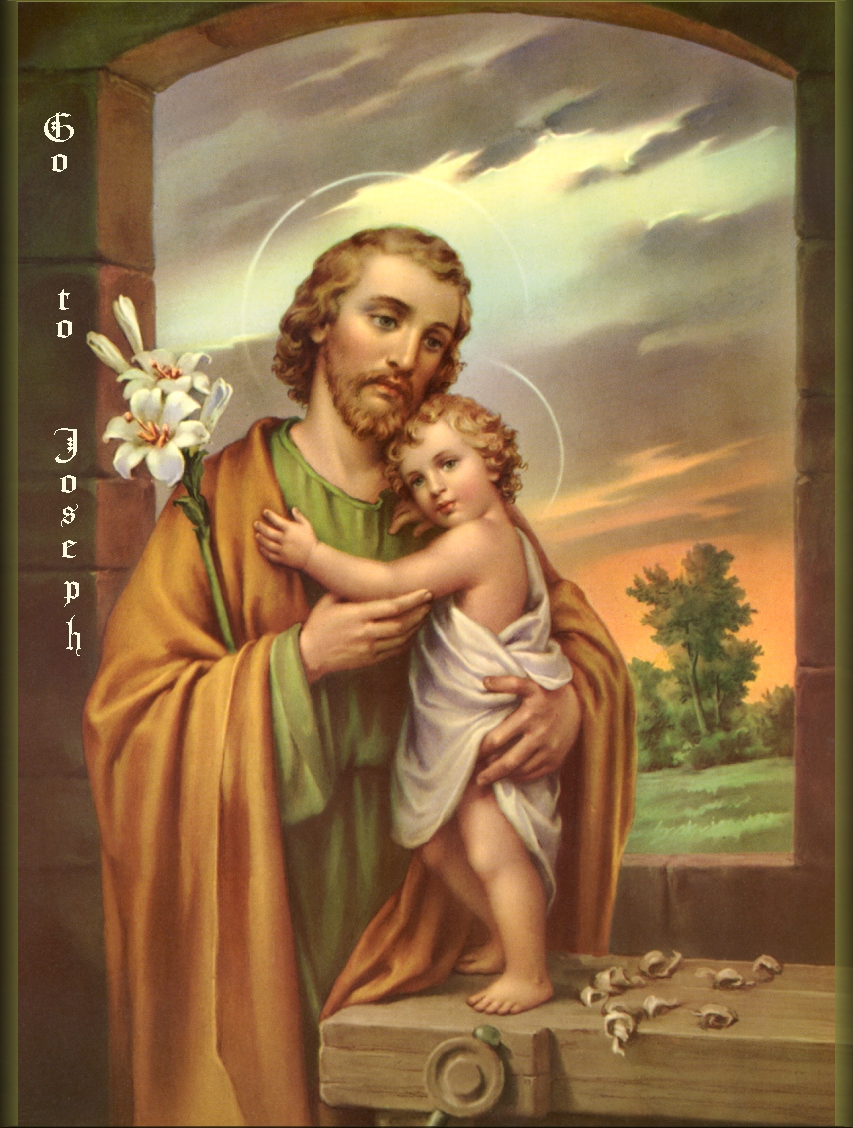
Everything we know about the husband of Mary and the foster father of Jesus comes from Scripture and that has seemed too little for those who made up legends about him.
We know he was a carpenter, a working man, for the skeptical Nazarenes ask about Jesus, "Is this not the carpenter's son?" (Matthew 13:55). He wasn't rich for when he took Jesus to theTemple to be circumcised and Mary to be purified he offered the sacrifice of two turtledoves or a pair of pigeons, allowed only for those who could not afford a lamb (Luke 2:24).
Despite his humble work and means, Joseph came from a royal lineage. Luke and Matthew disagree some about the details of Joseph's genealogy but they both mark his descent from David, the greatest king of Israel (Matthew 1:1-16 andLuke 3:23-38). Indeed the angel who first tells Joseph aboutJesus greets him as "son of David," a royal title used also for Jesus.
We know Joseph was a compassionate, caring man. When he discovered Mary was pregnant after they had been betrothed, he knew the child was not his but was as yet unaware that she was carrying the Son of God. He planned to divorce Mary according to the law but he was concerned for her suffering and safety. He knew that women accused toadultery could be stoned to death, so he decided to divorce her quietly and not expose her to shame or cruelty (Matthew 1:19-25).
We know Joseph was man of faith, obedient to whatever Godasked of him without knowing the outcome. When the angelcame to Joseph in a dream and told him the truth about the child Mary was carrying, Joseph immediately and without question or concern for gossip, took Mary as his wife. When the angel came again to tell him that his family was in danger, he immediately left everything he owned, all his family and friends, and fled to a strange country with his young wife and the baby. He waited in Egypt without question until the angel told him it was safe to go back (Matthew 2:13-23).
We know Joseph loved Jesus. His one concern was for the safety of this child entrusted to him. Not only did he leave his home to protect Jesus, but upon his return settled in the obscure town of Nazareth out of fear for his life. When Jesus stayed in the Temple we are told Joseph (along with Mary) searched with great anxiety for three days for him (Luke 2:48). We also know that Joseph treated Jesus as his own son for over and over the people of Nazareth say of Jesus, "Is this not the son of Joseph?" (Luke 4:22)
We know Joseph respected God. He followed God's commands in handling the situation with Mary and going to Jerusalem to have Jesus circumcised and Mary purified after Jesus' birth. We are told that he took his family to Jerusalem every year for Passover, something that could not have been easy for a working man.
Since Joseph does not appear in Jesus' public life, at his death, or resurrection, many historians believeJoseph probably had died before Jesus entered public ministry.
Joseph is the patron of the dying because, assuming he died before Jesus' public life, he died with Jesusand Mary close to him, the way we all would like to leave this earth.
Joseph is also patron of the universal Church, fathers, carpenters, and social justice.
We celebrate two feast days for Joseph: March 19 for Joseph the Husband of Mary and May 1 for Josephthe Worker.
There is much we wish we could know about Joseph -- where and when he was born, how he spent his days, when and how he died. But Scripture has left us with the most important knowledge: who he was -- "a righteous man" (Matthew 1:18).
In His Footsteps:
Joseph was foster father to Jesus. There are many children separated from families and parents who need foster parents. Please consider contacting your local Catholic Charities or Division of FamilyServices about becoming a foster parent.
Prayer:
Saint Joseph, patron of the universal Church, watch over the Church as carefully as you watched over Jesus, help protect it and guide it as you did with your adopted son. Amen

St Cyril Of Jerusalem

Feastday: March 18
315 - 386
"Make your fold with the sheep; flee from the wolves: depart not from the Church," Cyril admonished catechumens surrounded by heresy. These were prophetic words for Cyril was to be hounded by enemies and heretics for most of his life, and although they could exile him from his diocese he never left his beloved Church.
Cyril's life began a few years before Arianism (the heresy thatJesus was not divine or one in being with the Father) and he lived to see its suppression and condemnation at the end of his life. In between he was the victim of many of the power struggles that took place.
We know little about Cyril's early life. Historians estimate he was born about 315 and that he was brought up in Jerusalem. He speaks about the appearance of the sites of the Nativity and Holy Sepulchre before they were "improved" by human hands as if he were a witness. All we know of his family were that his parents were probably Christians and he seemed to care for them a great deal. He exhorted catechumens to honor parents "for however much we may repay them, yet we can never be to them what they as parents have been to us." We know he also had a sister and a nephew, Gelasius, who became a bishop and a saint.
He speaks as one who belonged to a group called the Solitaries. These were men who lived in their own houses in the cities but practiced a life of complete chastity, ascetism, and service.
After being ordained a deacon and then a priest, his bishop Saint Maximus respected him enough to put him in charge of the instruction of catechumens. We still have these catechetical lectures of Cyril's that were written down by someone in the congregation. When speaking of so many mysteries, Cyril anticipated the question, "But some one will say, If the Divine substance is incomprehensible, why then do you discourse of these things? So then, because I cannot drink up all the river, am I not even to take in moderation what is expedient for me? Because with eyes so constituted as mine I cannot take in all the sun, am I not even to look upon it enough to satisfy my wants? Or again, because I have entered into a great garden, and cannot eat all the supply of fruits, would you have me go away altogether hungry?.. I am attempting now to glorify the Lord, but not to describe him, knowing nevertheless that I shall fall short of glorifying God worthily, yet deeming it a work of piety even to attempt it at all."
When Maximus died, Cyril was consecrated as bishop of Jerusalem. Because he was supported by the Arian bishop of Caesarea, Acacius, the orthodox criticized the appointment and the Arians thought they had a friend. Both factions were wrong, but Cyril wound up in the middle.
When a famine hit Jerusalem, the poor turned to Cyril for help. Cyril, seeing the poor starving to death and having no money, sold some of the goods of the churches. This was something that other saints including Ambrose and Augustine had done and it probably saved many lives. There were rumors, however, that some of the vestments wound up as clothing for actors.
Actually, the initial cause of the falling out between Acacius and Cyril was territory not beliefs. Asbishop of Caesarea, Acacia had authority over all the bishops of Palestine. Cyril argued that his authority did not include Jerusalem because Jerusalem was an "apostolic see" -- one of the original sees set up by the apostles. When Cyril did not appear at councils that Acacius called, Acacius accused him of selling church goods to raise money and had him banished.
Cyril stayed in Tarsus while waiting for an appeal. Constantius called a council where the appeal was supposed to take place. The council consisted of orthodox, Arians, and semi-Arian bishops. WhenAcacius and his faction saw that Cyril and other exiled orthodox bishops were attending, they demanded that the persecuted bishops leave. Acacius walked out when the demand was not met. The other bishops prevailed on Cyril and the others to give in to this point because they didn't want Acaciusto have reason to deny the validity of the council. Acacius returned but left again for good when hiscreed was rejected -- and refused to come back even to give testimony against his enemy Cyril. The result of the council was the Acacius and the other Arian bishops were condemned. There's no final judgment on Cyril's case but it was probably thrown out when Acacius refused to testify and Cyril returned to Jerusalem.
This was not the end of Cyril's troubles because Acacius carried his story to the emperor -- embellishing it with details that it was a gift of the emperor's that was sold to a dancer who died wearing the robe. This brought about a new synod run by Acacius who now had him banished again on the basis of what somebishops of Tarsus had done while Cyril was there.
This exile lasted until Julian became emperor and recalled all exiled bishops, orthodox or Arian. Some said this was to exacerbate tension in the Church and increase his imperial power. So Cyril returned to Jerusalem. When Acacius died, each faction nominated their own replacement for Caesarea. Cyril appointed his nephew Gelasius -- which may seem like nepotism, except that all orthodox sources spoke of Gelasius' holiness. A year later both Cyril and Gelasius were driven out of Palestine again as the new emperor's consul reversed Julian's ruling.
Eleven years later, Cyril was allowed to go back to find a Jerusalem destroyed by heresy and strife. He was never able to put things completely right. He did attend the Council at Constantinople in 381 where the Nicene Creed and orthodoxy triumphed and Arianism was finally condemned. Cyril received justiceat the same Council who cleared him of all previous rumors and commended him for fighting "a goodfight in various places against the Arians."
Cyril had eight years of peace in Jerusalem before he died in 386, at about seventy years old.
From Wikipedia
Cyril of Jerusalem (Greek Κύριλλος Α΄ Ἱεροσολύμων) was a distinguished theologian of the early Church (ca. 313 – 386). He is venerated as a saint by the Roman Catholic Church, the Eastern Orthodox Church, and the Anglican Communion. In 1883, Cyril was declared a Doctor of the Church by Pope Leo XIII. He is highly respected in the Palestinian Christian Community.

Life and character

Little is known of his life before he became a bishop; the assignment of his birth to the year 315 rests on conjecture.  It is believed that Cyril came from a family of Christians and was immediately drawn to the Church. Most scholars  believe that Cyril was born and brought up in Caesarea of Palestine but some  say he may have been born in Jerusalem because of his early knowledge of the city's layout, but this could have been attributed to research or information he learned after moving there to become bishop.
St. Cyril was ordained a deacon by Bishop St. Macarius of Jerusalem in about 335 and a priest some eight years later by Bishop St. Maximus. About the end of 350 he succeeded St. Maximus in the See of Jerusalem.
Soon after his appointment, Cyril in his Letter to Constantius  of 351 recorded the appearance of a cross of light in the sky above Golgotha, witnessed by the whole population of Jerusalem. Cyril regards this as proof that Constantius' piety towards God ensures imperial victory. The Greek church commemorates this miracle on the 7th of May. Though in modern times the authenticity of the Letterhas been questioned, on the grounds that the word homoousios occurs in the final blessing, many scholars believe this may be a later interpolation, and accept the letter's authenticity on the grounds of other pieces of internal evidence.

Episcopacy

Soon, however, relations between Metropolitan Acacius of Caesarea and Cyril became tense. Acacius is presented as a leading Arian by the orthodox historians, and his opposition to Cyril in the 350s is attributed by these writers to this cause. Sozomen also suggests that the tension may have been increased by Acacius's jealousy of the importance assigned to St. Cyril's See by the Council of Nicaea, as well as by the threat posed to Caesarea by the rising influence of the see of Jerusalem as it developed into the prime Christian holy place and became a centre of pilgrimage.  But in fact, the tensions in the 350s were a question of the use of church property.  Cyril became well known for his charitable works in the City of Jerusalem. For example in the mid 350s the city of Jerusalem was hit with drastic food shortages at which point church historians Sozomen and Theodoret reported “Cyril secretly sold sacramental ornaments of the church and a valuable holy robe, fashioned with gold thread that the emperor Constantine had once donated for the bishop to wear when he performed the rite of Baptism”. It was also believed Cyril sold ornaments and many imperial gifts all in the name of charity to keep his people from starving. Besides his charitable works as Bishop Cyril had many responsibilities in city life. These duties included the administration of justice with the Episcopal court, the negotiation of ransom for captures, teaching and preaching to the masses, converting non-believers, offering spiritual guidance, maintaining political duties, and many other important duties. Cyril was constantly busy with work that ranged from offering Mass to meeting with the people of his flock and not to mention making it a top priority to make sure people were not starving or being seduced by the call of false idols and religious skeptics.
For two years, Cyril resisted Acacius' summons to account for his actions in selling off church property, but a council held under Acacius's influence in 357 deposed St. Cyril in his absence (having officially charged him with selling church property to help the poor) and forced him to retire to Tarsus. The following year, 359, in an atmospohere hostile to Acacius, the Council of Seleucia reinstated Cyril and deposed Acacius. In 360, though, this was reversed by Emperor Constantius, and Cyril suffered another year's exile from Jerusalem until the Emperor Julian's accession allowed him to return.
Cyril was once again banished from Jerusalem by the Arian Emperor Valens in 367. St. Cyril was able to return again at the accession of Emperor Gratian in 378, after which he remained undisturbed until his death in 386. St. Cyril's jurisdiction over Jerusalem was expressly confirmed by the First Council of Constantinople (381), at which he was present. At that council he voted for acceptance of the termhomoousios, having been finally convinced that there was no better alternative.  His story is perhaps best representative of those Eastern bishops (perhaps a majority), initially mistrustful of Nicaea, who came to accept the creed of that council, and the doctrine of the homoousion.

Theological position

Though his theology was at first somewhat indefinite in phraseology, he undoubtedly gave a thorough adhesion to the Nicene orthodoxy. Even if he did avoid the debatable term homooussios, he expressed its sense in many passages, which exclude equally Patripassianism, Sabellianism, and the formula "there was a time when the Son was not" attributed to Arius. In other points he takes the ordinary ground of the Eastern Fathers, as in the emphasis he lays on the freedom of the will, the autexousion (αὐτεξούσιον), and his imperfect realization of the factor so much more strongly brought out in the West: sin. To him sin is the consequence of freedom, not a natural condition. The body is not the cause, but the instrument of sin. The remedy for it is repentance, on which he insists. Like many of the Eastern Fathers, he has an essentially moralistic conception of Christianity[citation needed]. His doctrine of theResurrection is not quite so realistic as that of other Fathers; but his conception of the Church is decidedly empirical: the existing catholic Church form is the true one, intended by Christ, the completion of the Church of the Old Testament. His interpretation of the Eucharist is disputed. If he sometimes seems to approach the symbolic view, at other times he comes very close to a strong realistic doctrine. The bread and wine are not mere elements, but the body and blood of Christ.
Cyril of Jerusalem is often renowned for his beliefs in the nature of Jesus and God. His writings are filled with the loving and forgiving nature of God which was somewhat uncommon during his time period. Many religious leaders focusing on the wrath of God instilling a fear in their members. Cyril fills his writings with great lines of the healing power of forgiveness and the Holy Spirit like “The Spirit comes gently and makes himself known by his fragrance. He is not felt as a burden for God is light, very light. Rays of light and knowledge stream before him as the Spirit approaches. The Spirit comes with the tenderness of a true friend to save, to heal, to teach, to counsel, to strengthen and to console”. Cyril truly believes in the forgiving aspect of Christianity and knows the power it holds to turn those in pain towards the light of God. Cyril himself followed God's message of forgiveness himself many times throughout his life. Most clearly seen in his two major exiles where Cyril was disgraced and forced to leave his position and his people behind. He never wrote or showed any ill will towards those who wronged him. Cyril’s central messages also contain the primary principle of faith. Cyril new religion wasn’t about proving the existence of God or proving the divinity of Christ but rather instilling a faith in people. Cyril knew the power and importance of faith and tried at every opportunity to pass his faith onto others, allowing them to feel the presence of the Holy Spirit. Through his simple message Cyril became recognized as one of the most profound and admired Bishops in church history, which ultimately led to his canonization by the Christian church.

Catechetical Lectures

Cyril's famous twenty-three lectures given to catechumens in Jerusalem being prepared for, and after, baptism are best considered in two parts: the first eighteen lectures are common known as theCatechecical LecturesCatechetical Orations or Catechetical Homilies, while the final five are often called the Mystagogic Catecheses (μυσταγωγικαί), because they deal with the mysteries (μυστήρια) i.e.Sacraments of Baptism, Confirmation and the Eucharist.
His catechetical lectures (Greek Κατηχήσεις) ref>http://www.ccel.org/ccel/schaff/npnf207.ii.iv.html</ref> are generally assumed, on the basis of limited evidence, to have been delivered either in Cyril's early years as a bishop, around 350, or perhaps in 348, while Cyril was still a priest, deputising for his bishop, Maximus.  The Catechetical Lectures were given in the Martyrion, the basilica erected by Constantine.  The contain instructions on the principal topics of Christian faith and practice, in rather a popular than a scientific manner, full of a warm pastoral love and care for the catechumens to whom they were delivered. Each lecture is based upon a text of Scripture, and there is an abundance of Scriptural quotation throughout. In theCatechetical Lectures, parallel with the exposition of the Creed as it was then received in the Church of Jerusalem are vigorous polemics against pagan, Jewish, and heretical errors. They are of great importance for the light which they throw upon the method of instruction usual of that age, as well as upon the liturgical practises of the period, of which they give the fullest account extant.
In the 13th lecture, Cyril of Jerusalem discusses the Crucifixion and burial of Jesus Christ. The main themes that Cyril focuses on in these lectures are Original sin and Jesus’ sacrificing himself to save us from our sins. Also, the burial and Resurrection which occurred three days later proving the divinity of Jesus Christ and the loving nature of the Father. Cyril was very adamant about the fact that Jesus went to his death with full knowledge and willingness. Not only did he go willingly but throughout the process he maintained his faith and forgave all those who betrayed him and engaged in his execution. Cyril writes “who did not sin, neither was deceit found in his mouth, who, when he was reviled, did not revile, when he suffered did not threaten”.  This line by Cyril shows his belief in the selflessness of Jesus especially in this last final act of Love. The lecture also gives a sort of insight to what Jesus may have be feeling during the execution from the whippings and beatings, to the crown of thorns, to the nailing on the cross. Cyril intertwines the story with the messages Jesus told throughout his life before his execution relating to his final act. For example Cyril writes “I gave my back to those who beat me and my cheeks to blows; and my face I did not shield from the shame of spitting”. This clearly reflects the teachings of Jesus to turn the other cheeks and not raising your hands against violence because violence just begets violence begets violence. The segment of the Catechesis really reflects the voice Cyril maintained in all of his writing. The writings always have the central message of the bible; Cyril doesn’t try to add his own beliefs in reference to religious interpretation and remains grounded in true biblical teachings.


St. Patrick's Feast Day March 17th


Apostle of Ireland, born at Kilpatrick, near Dumbarton, in Scotland, in the year 387; died at Saul, Downpatrick, Ireland, 17 March, 493.

He had for his parents Calphurnius and Conchessa. The former belonged to a Roman family of high rank and held the office ofdecurio in Gaul or Britain. Conchessa was a near relative of the great patron of GaulSt. Martin of Tours. Kilpatrick still retains many memorials of Saint Patrick, and frequent pilgrimages continued far into the Middle Ages to perpetuate there the fame of hissanctity and miracles.
In his sixteenth year, Patrick was carried off into captivity by Irish marauders and was sold as a slave to a chieftan named Milchu in Dalriada, a territory of the present county of Antrim in Ireland, where for six years he tended his master's flocks in the valley of the Braid and on the slopes of Slemish, near the modern town of Ballymena. He relates in his "Confessio" that during his captivity while tending the flocks he prayed many times in the day: "the love of God", he added,
and His fear increased in me more and more, and the faith grew in me, and the spirit was roused, so that, in a single day, I have said as many as a hundred prayers, and in the night nearly the same, so that whilst in the woods and on the mountain, even before the dawn, I was roused to prayer and felt no hurt from it, whether there was snow or ice or rain; nor was there any slothfulness in me, such as I see now, because the spirit was then fervent within me.
In the ways of a benign Providence the six years of Patrick's captivity became a remote preparation for his future apostolate. He acquired a perfect knowledge of the Celtic tongue in which he would one day announce the glad tidings of Redemption, and, as his master Milchu was a druidical high priest, he became familiar with all the details of Druidism from whose bondage he was destined to liberate the Irish race.
Admonished by an angel he after six years fled from his cruel master and bent his steps towards the west. He relates in his "Confessio" that he had to travel about 200 miles; and his journey was probably towards Killala Bay and onwards thence to Westport. He found a ship ready to set sail and after some rebuffs was allowed on board. In a few days he was among his friends once more in Britain, but now his heart was set on devoting himself to the service of God in the sacred ministry. We meet with him at St. Martin's monastery at Tours, and again at the island sanctuary of Lérins which was just then acquiring widespread renown for learning and piety; and wherever lessons of heroic perfection in the exercise of Christian life could be acquired, thither the fervent Patrick was sure to bend his steps. No sooner had St. Germain entered on his great mission at Auxerre than Patrick put himself under his guidance, and it was at that great bishop's hands that Ireland's future apostle was a few years later promoted to the priesthood. It is the tradition in the territory of the Morini that Patrick under St. Germain'sguidance for some years was engaged in missionary work among them. When Germain commissioned by the Holy See proceeded to Britain to combat the erroneous teachings of Pelagius, he chose Patrick to be one of his missionary companions and thus it was his privilege to be associated with the representative of Rome in the triumphs that ensued over heresy and Paganism, and in the many remarkable events of the expedition, such as the miraculous calming of the tempest at sea, the visit to the relics atSt. Alban's shrine, and the Alleluia victory. Amid all these scenes, however, Patrick's thoughts turned towards Ireland, and fromtime to time he was favoured with visions of the children from Focluth, by the Western sea, who cried to him: "O holy youth, come back to Erin, and walk once more amongst us."
Pope St. Celestine I, who rendered immortal service to the Church by the overthrow of the Pelagian and Nestorian heresies, and by the imperishable wreath of honour decreed to the Blessed Virgin in the General Council of Ephesuscrowned his pontificate by an act of the most far-reaching consequences for the spread of Christianity and civilization, when he entrusted St. Patrick with the mission of gathering the Irish race into the one fold of ChristPalladius had already received that commission, but terrified by the fierce opposition of a Wicklow chieftain had abandoned the sacred enterprise. It was St. GermainBishop of Auxerre, who commended Patrick to the pope. The writer of St. Germain's Life in the ninth century, Heric of Auxerre, thus attests this important fact: "Since the glory of the father shines in the training of the children, of the many sons in Christ whom St. Germainis believed to have had as disciples in religion, let it suffice to make mention here, very briefly, of one most famous, Patrick, the special Apostle of the Irish nation, as the record of his work proves. Subject to that most holy discipleship for 18 years, he drank in no little knowledge in Holy Scripture from the stream of so great a well-spring. Germain sent him, accompanied by Segetius, hispriest, to CelestinePope of Rome, approved of by whose judgement, supported by whose authority, and strengthened by whoseblessing, he went on his way to Ireland." It was only shortly before his death that Celestine gave this mission to Ireland's apostle and on that occasion bestowed on him many relics and other spiritual gifts, and gave him the name "Patercius" or "Patritius", not as an honorary title, but as a foreshadowing of the fruitfulness and merit of his apostolate whereby he became pater civium (the father of his people). Patrick on his return journey from Rome received at Ivrea the tidings of the death of Palladius, and turning aside to the neighboring city of Turin received episcopal consecration at the hands of its great bishopSt. Maximus, and thence hastened on to Auxerre to make under the guidance of St. Germain due preparations for the Irish mission.
It was probably in the summer months of the year 433, that Patrick and his companions landed at the mouth of the Vantry River close by Wicklow Head. The Druids were at once in arms against him. But Patrick was not disheartened. The intrepid missionary resolved to search out a more friendly territory in which to enter on his mission. First of all, however, he would proceed towards Dalriada, where he had been a slave, to pay the price of ransom to his former master, and in exchange for the servitude and cruelty endured at his hands to impart to him the blessings and freedom of God's children. He rested for some days at the islands off the Skerries coast, one of which still retains the name of Inis-Patrick, and he probably visited the adjoining mainland, which in olden times was known as Holm Patrick. Tradition fondly points out the impression of St. Patrick's foot upon the hard rock — off the main shore, at the entrance to Skerries harbour. Continuing his course northwards he halted at the mouth of the River Boyne. A number of the natives there gathered around him and heard with joy in their own sweet tongue the glad tidings ofRedemption. There too he performed his first miracle on Irish soil to confirm the honour due to the Blessed Virgin, and the Divine birth of our Saviour. Leaving one of his companions to continue the work of instruction so auspiciously begun, he hastened forward to Strangford Loughand there quitting his boat continued his journey over land towards Slemish. He had not proceeded far when a chieftain, named Dichu, appeared on the scene to prevent his further advance. He drew his sword to smite the saint, but his arm became rigid as a statue and continued so until he declared himself obedient to Patrick. Overcome by the saint'smeekness and miracles, Dichu asked for instruction and made a gift of a large sabhall (barn), in which the sacred mysteries were offered up. This was the first sanctuary dedicated by St. Patrick in Erin. It became in later years a chosen retreat of the saint. Amonastery and church were erected there, and the hallowed site retains the name Sabhall (pronounced Saul) to the present day. Continuing his journey towards Slemish, the saint was struck with horror on seeing at a distance the fort of his old master Milchu enveloped in flames. The fame of Patrick's marvelous power of miracles preceeded him. Milchu, in a fit of frenzy, gathered his treasures into his mansion and setting it on fire, cast himself into the flames. An ancient record adds: "His pride could not endure the thought of being vanquished by his former slave".
Returning to Saul, St. Patrick learned from Dichu that the chieftains of Erin had been summoned to celebrate a special feast at Tara by Leoghaire, who was the Ard-Righ, that is, the Supreme Monarch of Ireland. This was an opportunity which Patrick would not forego; he would present himself before the assembly, to strike a decisive blow against the Druidism that held the nation captive, and to secure freedom for the glad tidings of Redemption of which he was the herald. As he journeyed on he rested for some days at the house of a chieftain named Secsnen, who with his household joyfully embraced the Faith. The youthful Benen, or Benignus, son of the chief, was in a special way captivated by the Gospel doctrines and the meekness of Patrick. Whilst thesaint slumbered he would gather sweet-scented flowers and scatter them over his bosom, and when Patrick was setting out, continuing his journey towards Tara, Benen clung to his feet declaring that nothing would sever him from him. "Allow him to have his way", said St. Patrick to the chieftain, "he shall be heir to my sacred mission." Thenceforth Benen was the inseparable companion of the saint, and the prophecy was fulfilled, for Benen is named among the "comhards" or sucessors of St. Patrick inArmagh.
It was on 26 March, Easter Sunday, in 433, that the eventful assembly was to meet at Tara, and the decree went forth that from the preceeding day the fires throughout the kingdom should be extinguished until the signal blaze was kindled at the royal mansion. The chiefs and Brehons came in full numbers and the druids too would muster all their strength to bid defiance to the herald of good tidings and to secure the hold of their superstition on the Celtic race, for their demoniac oracles had announced that the messenger of Christ had come to Erin. St. Patrick arrived at the hill of Slane, at the opposite extremity of the valley from Tara, on Easter Eve, in that year the feast of the Annunciation, and on the summit of the hill kindled the Paschal fire. Thedruids at once raised their voice. "O King", (they said) "live for ever; this fire, which has been lighted in defiance of the royal edict, will blaze for ever in this land unless it be this very night extinguished." By order of the king and the agency of the druids, repeated attempts were made to extinguish the blessed fire and to punish with death the intruder who had disobeyed the royal command. But the fire was not extinguished and Patrick shielded by the Divine power came unscathed from their snares and assaults. On Easter Day the missionary band having at their head the youth Benignus bearing aloft a copy of the Gospels, and followed by St. Patrick who with mitre and crozier was arrayed in full episcopal attire, proceeded in processional order to Tara. The druids and magicians put forth all their strength and employed all their incantations to maintain their sway over the Irishrace, but the prayer and faith of Patrick achieved a glorious triumph. The druids by their incantations overspread the hill and surrounding plain with a cloud of worse than Egyptian darkness. Patrick defied them to remove that cloud, and when all their efforts were made in vain, at his prayer the sun sent forth its rays and the brightest sunshine lit up the scene. Again bydemoniac power the Arch-Druid Lochru, like Simon Magus of old, was lifted up high in the air, but when Patrick knelt in prayer thedruid from his flight was dashed to pieces upon a rock.
Thus was the final blow given to paganism in the presence of all the assembled chieftains. It was, indeed, a momentous day for the Irish race. Twice Patrick pleaded for the Faith before Leoghaire. The king had given orders that no sign of respect was to be extended to the strangers, but at the first meeting the youthful Erc, a royal page, arose to show him reverence; and at the second, when all the chieftains were assembled, the chief-bard Dubhtach showed the same honour to the saint. Both these heroic men became fervent disciples of the Faith and bright ornaments of the Irish Church. It was on this second solemn occasion that St. Patrick is said to have plucked a shamrock from the sward, to explain by its triple leaf and single stem, in some rough way, to the assembled chieftains, the great doctrine of the Blessed Trinity. On that bright Easter Day, the triumph ofreligion at Tara was complete. The Ard-Righ granted permission to Patrick to preach the Faith throughout the length and breadth of Erin, and the druidical prophecy like the words of Balaam of old would be fulfilled: the sacred fire now kindled by the saintwould never be extinguished.
The beautiful prayer of St. Patrick, popularly known as "St. Patrick's Breast-Plate", is supposed to have been composed by him in preparation for this victory over Paganism. The following is a literal translation from the old Irish text:
I bind to myself today
The strong virtue of the Invocation of the Trinity:
believe the Trinity in the Unity
The Creator of the Universe.

I bind to myself today
The virtue of the Incarnation of Christ with His Baptism,
The virtue of His crucifixion with His burial,
The virtue of His Resurrection with His Ascension,
The virtue of His coming on the Judgement Day.

I bind to myself today
The virtue of the love of seraphim,
In the obedience of angels,
In the hope of resurrection unto reward,
In prayers of Patriarchs,
In predictions of Prophets,
In preaching of Apostles,
In faith of Confessors,
In purity of holy Virgins,
In deeds of righteous men.

I bind to myself today
The power of Heaven,
The light of the sun,
The brightness of the moon,
The splendour of fire,
The flashing of lightning,
The swiftness of wind,
The depth of sea,
The stability of earth,
The compactness of rocks.

I bind to myself today
God's Power to guide me,
God's Might to uphold me,
God's Wisdom to teach me,
God's Eye to watch over me,
God's Ear to hear me,
God's Word to give me speech,
God's Hand to guide me,
God's Way to lie before me,
God's Shield to shelter me,
God's Host to secure me,
Against the snares of demons,
Against the seductions of vices,
Against the lusts of nature,
Against everyone who meditates injury to me,
Whether far or near,
Whether few or with many.

I invoke today all these virtues
Against every hostile merciless power
Which may assail my body and my soul,
Against the incantations of false prophets,
Against the black laws of heathenism,
Against the false laws of heresy,
Against the deceits of idolatry,
Against the spells of women, and smiths, and druids,
Against every knowledge that binds the soul of man.

Christ, protect me today
Against every poison, against burning,
Against drowning, against death-wound,
That I may receive abundant reward.

Christ with me, Christ before me,
Christ behind me, Christ within me,
Christ beneath me, Christ above me,
Christ at my right, Christ at my left,
Christ in the fort,
Christ in the chariot seat,
Christ in the poop [deck],
Christ in the heart of everyone who thinks of me,
Christ in the mouth of everyone who speaks to me,
Christ in every eye that sees me,
Christ in every ear that hears me.

I bind to myself today
The strong virtue of an invocation of the Trinity,
believe the Trinity in the Unity
The Creator of the Universe.
St. Patrick remained during Easter week at Slane and Tara, unfolding to those around him the lessons of Divine truth. Meanwhile the national games were being celebrated a few miles distant at Tailten (now Telltown) in connection with the royal feast. St. Patrick proceeding thither solemnly administered baptism to Conall, brother of the Ard-Righ Leoghaire, on Wednesday, 5 April. Benen and others had already been privately gathered into the fold of Christ, but this was the first public administering ofbaptism, recognized by royal edict, and hence in the ancient Irish Kalendars to the fifth of April is assigned "the beginning of the Baptism of Erin". This first Christian royal chieftain made a gift to Patrick of a site for a church which to the present day retains the name of Donagh-Patrick. The blessing of heaven was with Conall's familySt. Columba is reckoned among his descendants, and many of the kings of Ireland until the eleventh century were of his race. St. Patrick left some of his companions to carry on the work of evangelization in Meath, thus so auspiciously begun. He would himself visit the other territories. Some of the chieftains who had come to Tara were from Focluth, in the neighbourhood of Killala, in Connaught, and as it was the children of Focluth who in vision had summoned him to return to Ireland, he resolved to accompany those chieftains on their return, that thus the district of Focluth would be among the first to receive the glad tidings of Redemption. It affords a convincing proof of the difficulties that St. Patrick had to overcome, that though full liberty to preach the Faith throughout Erin was granted by the monarch of Leoghaire, nevertheless, in order to procure a safe conduct through the intervening territories whilst proceeding towards Connaught he had to pay the price of fifteen slaves. On his way thither, passing through Granard he learned that at Magh-Slecht, not far distant, a vast concourse was engaged in offering worship to the chief idol Crom-Cruach. It was a huge pillar-stone, covered with slabs of gold and silver, with a circle of twelve minor idols around it. He proceeded thither, and with hiscrosier smote the chief idol that crumbled to dust; the others fell to the ground. At Killala he found the whole people of the territory assembled. At his preaching, the king and his six sons, with 12,000 of the people, became docile to the Faith. He spent seven years visiting every district of Connaught, organizing parishes, forming dioceses, and instructing the chieftains and people.
On the occasion of his first visit to Rathcrogan, the royal seat of the kings of Connaught, situated near Tulsk, in the County ofRoscommon, a remarkable incident occurred, recorded in many of the authentic narratives of the saint's life. Close by the clear fountain of Clebach, not far from the royal abode, Patrick and his venerable companions had pitched their tents and at early dawn were chanting the praises of the Most High, when the two daughters of the Irish monarch — Ethne, the fair, and Fedelm, the ruddy — came thither, as was their wont, to bathe. Astonished at the vision that presented itself to them, the royal maidens cried out: "Who are ye, and whence do ye come? Are ye phantoms, or fairies, or friendly mortals?" St. Patrick said to them: "It were better you would adore and worship the one true God, whom we announce to you, than that you would satisfy your curiosity by such vain questions." And then Ethne broke forth into the questions:
"Who is God?"
"And where is God?"
"Where is His dwelling?"
"Has He sons and daughters?"
"Is He rich in silver and gold?"
"Is He everlasting? is He beautiful?"
"Are His daughters dear and lovely to the men of this world?"
"Is He on the heavens or on earth?"
"In the sea, in rivers, in mountains, in valleys?"
"Make Him known to us. How is He to be seen?"
"How is He to be loved? How is He to be found?"
"Is it in youth or is it in old age that He may be found?"
But St. Patrick, filled with the Holy Ghost, made answer:
"God, whom we announce to you, is the Ruler of all things."
"The God of heaven and earth, of the sea and the rivers."
"The God of the sun, and the moon, and all the stars."
"The God of the high mountains and of the low-lying valleys."
"The God who is above heaven, and in heaven, and under heaven."
"His dwelling is in heaven and earth, and the sea, and all therein."
"He gives breath to all."
"He gives life to all."
"He is over all."
"He upholds all."
"He gives light to the sun."
"He imparts splendour to the moon."
"He has made wells in the dry land, and islands in the ocean."
"He has appointed the stars to serve the greater lights."
"His Son is co-eternal and co-equal with Himself."
"The Son is not younger than the Father."
"And the Father is not older than the Son."
"And the Holy Ghost proceeds from them."
"The Father and the Son and the Holy Ghost are undivided."
"But I desire by Faith to unite you to the Heavenly King, as you are daughters of an earthly king."
The maidens, as if with one voice and one heart, said: "Teach us most carefully how we may believe in the Heavenly King; show us how we may behold Him face to face, and we will do whatsoever you shall say to us."
And when he had instructed them he said to them: "Do you believe that by baptism you put off the sin inherited from the firstparents."
They answered: "We believe."
"Do you believe in penance after sin?"
"We believe."
"Do you believe in life after death?" Do you believe in resurrection on the Day of Judgement?"
"We believe."
"Do you believe in the unity of the Church?"
"We believe."
Then they were baptized, and were clothed in white garments. And they besought that they might behold the face of Christ. And the saint said to them: "You cannot see the face of Christ unless you taste death, and unless you receive the Sacrifice." They answered: "Give us the Sacrifice, so that we may be able to behold our Spouse." And the ancient narrative adds: "when they received the Eucharist of God, they slept in death, and they were placed upon a couch, arrayed in their white baptismalrobes."
In 440 St. Patrick entered on the special work of the conversion of Ulster. Under the following year, the ancient annalists relate a wonderful spread of the Faith throughout the province. In 444 a site for a church was granted at Armagh by Daire, the chieftain of the district. It was in a valley at the foot of a hill, but the saint was not content. He had special designs in his heart for that district, and at length the chieftain told him to select in his territory any site he would deem most suitable for hisreligious purpose. St. Patrick chose that beautiful hill on which the old cathedral of Armagh stands. As he was marking out thechurch with his companions, they came upon a doe and fawn, and the saint's companions would kill them for food; but St. Patrick would not allow them to do so, and, taking the fawn upon his shoulders, and followed by the doe, he proceeded to a neighbouring hill, and laid down the fawn, and announced that there, in future times, great glory would be given to the Most High. It was precisely upon that hill thus fixed by St. Patrick that, a few years ago, there was solemnly dedicated the new and beautiful Catholic cathedral of Armagh. A representative of the Holy See presided on the occasion, and hundreds of priests andbishops were gathered there; and, indeed, it might truly be said, the whole Irish race on that occasion offered up that gloriouscathedral to the Most High as tribute to their united faith and piety, and their never-failing love of God.
From Ulster St. Patrick probably proceeded to Meath to consolidate the organization of the communities there, and thence he continued his course through Leinster. Two of the saint's most distinguished companions, St. Auxilius and St. Iserninus, had the rich valley of the Liffey assigned to them. The former's name is still retained in the church which he founded at Killossy, while the latter is honoured as the first Bishop of Kilcullen. As usual, St. Patrick's primary care was to gather the ruling chieftains into the fold. At Naas, the royal residence in those days, he baptised two sons of the King of Leinster. Memorials of the saint still abound in the district — the ruins of the ancient church which he founded, his holy well, and the hallowed sites in which the power ofGod was shown forth in miracles. At Sletty, in the immediate neighborhood of Carlow, St. Fiacc, son of the chief Brehon, Dubthach, was installed as bishop, and for a considerable time that see continued to be the chief centre of religion for all Leinster. St. Patrick proceeded through Gowran into Ossory; here he erected a church under the invocation of St. Martin, near the present city of Kilkenny, and enriched it with many precious relics which he had brought from Rome. It was in Leinster, on the borders of the present counties of Kildare and Queen's, that Odhran, St. Patrick's charioteer, attained the martyr's crown. The chieftain of that district honoured the demon-idol, Crom Cruach, with special worship, and, on hearing of that idol being cast down, vowed to avenge the insult by the death of our apostle. Passing through the territory, Odhran overheard the plot that was being organized for the murder of St. Patrick, and as they were setting out in the chariot to continue their journey, asked the saint, as a favour, to take thereins, and to allow himself, for the day, to hold the place of honour and rest. This was granted, and scarcely had they set out when a well-directed thrust of a lance pierced the heart of the devoted charioteer, who thus, by changing places, saved St. Patrick's life, and won for himself the martyr's crown.
St. Patrick next proceeded to Munster. As usual, his efforts were directed to combat error in the chief centres of authority, knowing well that, in the paths of conversion, the kings and chieftains would soon be followed by their subjects. At "Cashel of the Kings" he was received with great enthusiasm, the chiefs and Brehons and people welcoming him with joyous acclaim. While engaged in the baptism of the royal prince Aengus, son of the King of Munster, the saint, leaning on his crosier, pierced with its sharp point the prince's foot. Aengus bore the pain unmoved. When St. Patrick, at the close of the ceremony, saw the blood flow, and asked him why he had been silent, he replied, with genuine heroism, that he thought it might be part of the ceremony, a penalty for the joyous blessings of the Faith that were imparted. The saint admired his heroism, and, taking the chieftain's shield, inscribed on it a cross with the same point of the crozier, and promised that that shield would be the signal of countless spiritual and temporal triumphs.
Our apostle spent a considerable time in the present County of Limerick. The fame of his miracles and sanctity had gone before him, and the inhabitants of Thomond and northern Munster, crossing the Shannon in their frail coracles, hastened to receive his instruction. When giving his blessing to them on the summit of the hill of Finnime, looking out on the rich plains before him, he is said to have prophesied the coming of St. Senanus: "To the green island in the West, at the mouth of the sea [i.e., Inis-Cathaigh, now Scattery Island, at the mouth of the Shannon, near Kilrush], the lamp of the people of God will come; he will be the head of counsel to all this territory." At Sangril (now Singland), in Limerick, and also in the district of Gerryowen, the holy wells of the saint are pointed out, and the slab of rock, which served for his bed, and the altar on which every day he offered up the Holy Sacrifice. On the banks of the Suit, and the Blackwater, and the Lee, wherever the saint preached during the seven years he spent in Munster, a hearty welcome awaited him. The ancient Life attests: "After Patrick had founded cells andchurches in Munster, and had ordained persons of every grade, and healed the sick, and resuscitated the dead, he bade them farewell, and imparted his blessing to them." The words of this blessing, which is said to have been given from the hills of Tipperary, as registered in the saint's Life, to which I have just referred, are particularly beautiful:
blessing on the Munster people —
Men, youths, and women;
blessing on the land
That yields them fruit.

blessing on every treasure
That shall be produced on their plains,
Without any one being in want of help,
God's blessing be on Munster.

blessing on their peaks,
On their bare flagstones,
blessing on their glens,
blessing on their ridges.

Like the sand of the sea under ships,
Be the number in their hearths;
On slopes, on plains,
On mountains, on hills, a blessing.
St. Patrick continued until his death to visit and watch over the churches which he had founded in all the provinces in Ireland. He comforted the faithful in their difficulties, strengthened them in the Faith and in the practice of virtue, and appointed pastorsto continue his work among them. It is recorded in his Life that he consecrated no fewer than 350 bishops. He appointed St. Loman to Trim, which rivalled Armagh itself in its abundant harvest of piety. St. Guasach, son of his former master, Milchu, became Bishop of Granard, while the two daughters of the same pagan chieftan founded close by, at Clonbroney, a convent of pious virgins, and merited the aureola of sanctity. St. Mel, nephew of our apostle, had the charge of Ardagh; St. MacCarthem, who appears to have been patricularly loved by St. Patrick, was made Bishop of Clogher. The narrative in the ancient Life of thesaint regarding his visit to the district of Costello, in the County of Mayo, serves to illustrate his manner of dealing with the chieftains. He found, it says, the chief, Ernasc, and his son, Loarn, sitting under a tree, "with whom he remained, together with his twelve companions, for a week, and they received from him the doctrine of salvation with attentive ear and mind. Meanwhile he instructed Loarn in the rudiments of learning and piety." A church was erected there, and, in after years, Loarn was appointed to its charge.
The manifold virtues by which the early saints were distinguished shone forth in all their perfection in the life of St. Patrick. When not engaged in the work of the sacred ministry, his whole time was spent in prayer. Many times in the day he armed himself with the sign of the Cross. He never relaxed his penitential exercises. Clothed in a rough hair-shirt, he made the hard rock his bed. His disinterestedness is specially commemorated. Countless converts of high rank would cast their precious ornaments at his feet, but all were restored to them. He had not come to Erin in search of material wealth, but to enrich her with the priceless treasures of the Catholic Faith.
From time to time he withdrew from the spiritual duties of his apostolate to devote himself wholly to prayer and penance. One of his chosen places of solitude and retreat was the island of Lough Derg, which, to our own day, has continued to be a favourite resort of pilgrims, and it is known as St. Patrick's Purgatory. Another theatre of his miraculous power and piety and penitential austerities in the west of Ireland merits particular attention. In the far west of Connaught there is a range of tall mountains, which, arrayed in rugged majesty, bid defiance to the waves and storms of the Atlantic. At the head of this range arises a stately cone in solitary grandeur, about 4000 feet in height, facing Clew Bay, and casting its shadow over the adjoining districts of Aghagower and Westport. This mountain was known in pagan times as the Eagle Mountain, but ever since Ireland was enlightened with the light of Faith it is known as Croagh Patrick, i.e. St. Patrick's mountain, and is honoured as the Holy Hill, theMount Sinai, of Ireland.
St. Patrick, in obedience to his guardian angel, made this mountain his hallowed place of retreat. In imitation of the great Jewish legislator on Sinai, he spent forty days on its summit in fasting and prayer, and other penitential exercises. His only shelter from the fury of the elements, the wind and rain, the hail and snow, was a cave, or recess, in the solid rock; and the flagstone on which he rested his weary limbs at night is still pointed out. The whole purpose of his prayer was to obtain special blessings and mercy for the Irish race, whom he evangelized. The demons that made Ireland their battlefield mustered all their strength totempt the saint and disturb him in his solitude, and turn him away, if possible, from his pious purpose. They gathered around the hill in the form of vast flocks of hideous birds of prey. So dense were their ranks that they seemed to cover the whole mountain, like a cloud, and they so filled the air that Patrick could see neither sky nor earth nor ocean. St. Patrick besought God to scatter the demons, but for a time it would seem as if his prayers and tears were in vain. At length he rang his sweet-sounding bell,symbol of his preaching of the Divine truths. Its sound was heard all over the valleys and hills of Erin, everywhere bringing peace and joy. The flocks of demons began to scatter. He flung his bell among them; they took to precipitate flight, and cast themselves into the ocean. So complete was the saint's victory over them that, as the ancient narrative adds, "for seven years no evil thing was to be found in Ireland."
The saint, however, would not, as yet, descend from the mountain. He had vanquished the demons, but he would now wrestle with God Himself, like Jacob of old, to secure the spiritual interests of his people. The angel had announced to him that, to reward his fidelity in prayer and penance, as many of his people would be gathered into heaven as would cover the land and sea as far as his vision could reach. Far more ample, however, were the aspirations of the saint, and he resolved to persevere infasting and prayer until the fullest measure of his petition was granted. Again and again the angel came to comfort him, announcing new concessions; but all these would not suffice. He would not relinquish his post on the mountain, or relax hispenance, until all were granted. At length the message came that his prayers were heard:
  • many souls would be free from the pains of purgatory through his intercession;
  • whoever in the spirit of penance would recite his hymn before death would attain the heavenly reward;
  • barbarian hordes would never obtain sway in his Church;
  • seven years before the Judgement Day, the sea would spread over Ireland to save its people from the temptations and terrors of the Antichrist; and
  • greatest blessing of all, Patrick himself should be deputed to judge the whole Irish race on the last day.
Such were the extraordinary favors which St. Patrick, with his wrestling with the Most High, his unceasing prayers, his unconquerable love of heavenly things, and his unremitting penitential deeds, obtained for the people whom he evangelized.
It is sometimes supposed that St. Patrick's apostolate in Ireland was an unbroken series of peaceful triumphs, and yet it was quite the reverse. No storm of persecution was, indeed stirred up to assail the infant Church, but the saint himself was subjected to frequent trials at the hands of the druids and of other enemies of the Faith. He tells us in his "Confessio" that no fewer than twelve times he and his companions were seized and carried off as captives, and on one occasion in particular he was loaded with chains, and his death was decreed. But from all these trials and sufferings he was liberated by a benignProvidence. It is on account of the many hardships which he endured for the Faith that, in some of the ancient Martyrologies, he is honoured as a martyr.
St. Patrick, having now completed his triumph over Paganism, and gathered Ireland into the fold of Christ, prepared for the summons to his rewardSt. Brigid came to him with her chosen virgins, bringing the shroud in which he would be enshrined. It is recorded that when St. Patrick and St. Brigid were united in their last prayer, a special vision was shown to him. He saw the whole of Ireland lit up with the brightest rays of Divine Faith. This continued for centuries, and then clouds gathered around the devoted island, and, little by little, the religious glory faded away, until, in the course of centuries, it was only in the remotest valleys that some glimmer of its light remained. St. Patrick prayed that the light would never be extinguished, and, as he prayed, the angel came to him and said: "Fear not: your apostolate shall never cease." As he thus prayed, the glimmering light grew in brightness, and ceased not until once more all the hills and valleys of Ireland were lit up in their pristine splendour, and then theangel announced to St. Patrick: "Such shall be the abiding splendour of Divine truth in Ireland."
At Saul (Sabhall), St. Patrick received the summons to his reward on 17 March, 493 [See note above — Ed.]. St. Tassachadministered the last sacraments to him. His remains were wrapped in the shroud woven by St. Brigid's own hands. The bishopsand clergy and faithful people from all parts crowded around his remains to pay due honour to the Father of their Faith. Some of the ancient Lives record that for several days the light of heaven shone around his bier. His remains were interred at the chieftan's Dun or Fort two miles from Saul, where in after times arose the cathedral of Down.